
- Since March 7, the Operators block numberings that are not attributed to any user or service, as well as those calls and SMS that are of international origin (except those numbers that are in roaming), but which pretend to have originated in a Spanish number to deceive the citizen
- The Plan also includes measures for the identification of commercial and customer service calls, which since the order was approved can only be made from geographical numbering, numbering attributed specifically for customer service or from numbers 800 and 900.
- In addition, the approval of the Customer Services Law will allow the attribution of a specific numbering for commercial calls, thus reinforcing the commitment of the Government to the protection of users and users of Telecommunications.
About 135 million calls and more than 5 million SMS with fraudulent intentions blocked since the month of March
11/12/2025
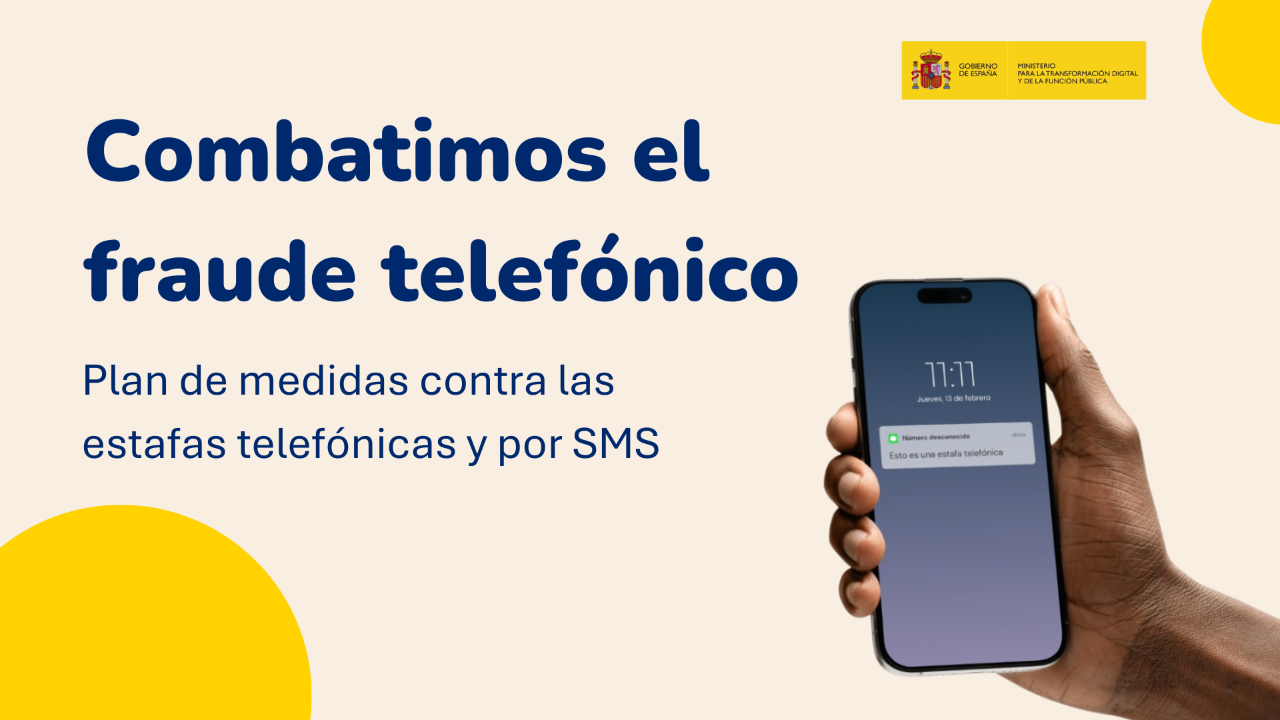
Telecom operators update blocked call and SMS data since March 7, when the government’s Anti-Scam Plan came into effect
On March 7 of this year, the first measures of the Government’s Anti-Fraud Plan came into force: a Ministerial Order that forced telecom operators to block certain communications (calls and SMS) with fraudulent intentions. From that date until November 30, operators report having blocked almost 135 million calls (134,985,321) and more than 5 million SMS (5,219,098).
As the months have gone by since the entry into force of the Ministerial Order, the number of blocked calls and SMS has increased.
In August, when the first evaluation of the plan was made, in the period from March 7 to July 31, the number of blocked calls amounted to about 48 million calls (47,971,400), while between August and November operators report 87,013,921 blocked calls, that is 81% more blocked calls than in the previous period. As for SMS, as of August, more than 2 million (2,212,950) were blocked compared to 3,006,148 that were blocked between August and November, 35% more SMS intercepted.
“It is clear that the Government’s SMS and telephone anti-fraud plan is working,” said the Minister for Digital Transformation and Public Service, Óscar López, who also recalled that “there is still one last measure that due to its technical complexity will be launched in 2026, and will have a substantial impact on the fraudulent SMS received by citizens.”
This measure is the creation of an official database with alphanumeric codes used by companies and public administrations as identifiers in SMS. The database will be managed by the National Commission of Markets and Competition (CNMC) and will allow the registration and verification of these identifiers.
This will guarantee the authenticity of communications, protect the identity of legitimate entities, and facilitate the detection and blocking of attempts to supplant. The measure is very important because many SMS fraud attempts simulate coming from a legitimate entity, such as a transport company or a banking entity, to obtain information or execute a harmful program.
Measures in force
The Government Plan came into effect on March 7. From that date, operators have the obligation to block numbers that are not attributed to any user or service, for example, numbers starting with 3 or 4.
Subsequently, since June 7, operators are also blocking calls and SMS that are of international origin (except those numbers that are in roaming), but they pretend to have originated in a Spanish number to deceive the citizen, one of the most common practices in telephone fraud attempts.
Commercial calls
In addition, the Plan prohibits commercial and customer service calls from mobile numbers, since a significant part of the scams occurred when the citizen received calls from national mobiles that are not kept in his/her diary, so he/she cannot identify the caller.
Commercial and customer service calls can now only be made with geographical numbering, numbering attributed specifically for commercial communications or from numbers 800 and 900. These numberings are no longer restricted exclusively to the reception of calls, also allowing them to be issued.
In addition, the Customer Service Act, which is being put to the vote in Congress today for final approval, has incorporated one more measure: the attribution of a specific numbering for commercial calls that will be implemented in a period of about six months. From that date, commercial calls aimed at attracting new customers (telemarketing) will only be able to use the new numerical range established for this purpose.
La Office of Telecommunications User Support It resolves doubts about the rights of users and allows claims to be filed, for example, in the event that a citizen continues to receive commercial calls from mobile numbering.