
Radio equipment marketed in Spain must meet the following essential requirements:
- Protection of the health and safety of persons and animals and property including targets for safety requirements under Directive 2014/35/EU without voltage limit.
- An adequate level of electromagnetic compatibility in accordance with Directive 2014/30/EU.
- Effective and efficient use of the radio spectrum.
To this end, the manufacturer must carry out tests with appropriate technical standards. In particular, if harmonised technical standards are used, they shall presume conformity with the essential requirements that apply. The manufacturer can only benefit from this if they are used properly, with the appropriate versions and deadlines. The updated versions of the harmonised technical standards approved by the European Commission.
In order to carry out the above process (conformity assessment), the manufacturer has three mechanisms:
- Internal production control (Module A).
- EU-type examination followed by conformity to type based on internal production control (B+C modules).
- Conformity based on full quality assurance (Module H).
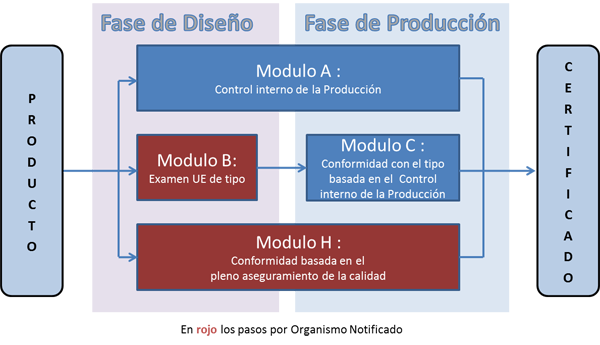
The manufacturer can choose the procedure to be followed to assess conformity, depending on the use of harmonised standards. In particular:
- For the essential requirements of safety and electromagnetic compatibility, you can use any procedure.
- For the radio spectrum requirement, you can only use Module A if you have applied harmonised technical standards. In the remaining case (non-harmonised standards or partial use of harmonised standards), you must use the B+C module or the H module.
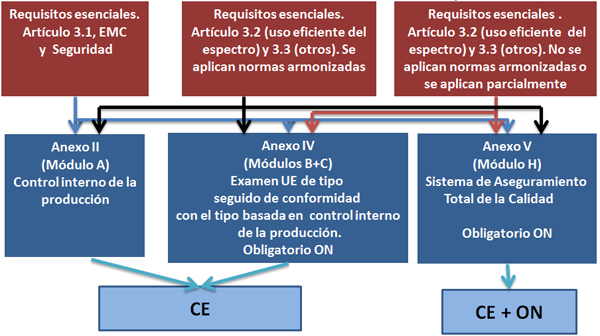
Once the process described has been completed, the manufacturer must:
- Issue a declaration of conformity in Spanish.
- Insert the CE marking on the equipment, on the packaging and in the instruction manual.