
The Government presents the Preliminary Draft of the General Telecommunications Law to a public audience
10/09/2020
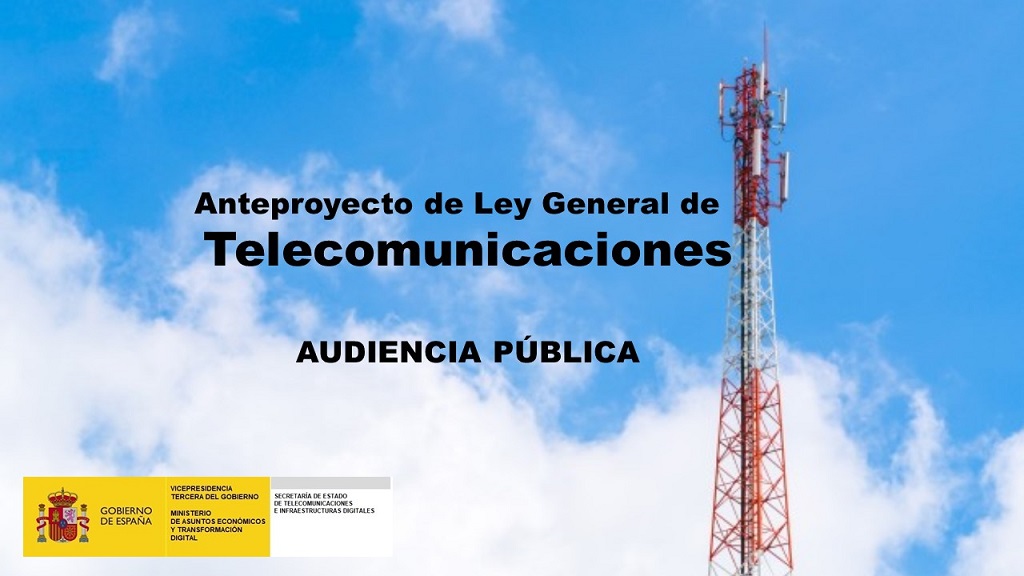
Today the public hearing period for the Preliminary Draft General Telecommunications Law (APL) has begun, to which contributions can be made until October 13 on the website of the Ministry of Economic Affairs and Digital Transformation.
Today the public hearing period for the Preliminary Draft General Telecommunications Law (APL) has begun, to which contributions can be made until October 13 on the website of the Ministry of Economic Affairs and Digital Transformation.
The future law will transpose into the Spanish legal system Directive (EU) 2018/1972 of the European Parliament and of the Council, of December 11, 2018, establishing the European code of electronic communications.
The processing and approval of a new General Telecommunications Law is one of the commitments of the “Spain Digital 2025” strategy in the field of connectivity, the cornerstone of digital transformation.
The preliminary draft includes the regulation not only of electronic communications services, but also aspects relating to telecommunications equipment, common telecommunications infrastructures in buildings and all uses of the public radio domain.
As a novelty, for the first time interpersonal communication services not based on numbering or messaging are regulated. Obligations of an administrative nature are imposed, such as registration in the Registry of Operators and the obligation to observe security measures in accordance with the risks inherent to their differentiated nature with respect to traditional services.
The health crisis of COVID-19 has highlighted telecommunications networks, so the preliminary project pays special attention to promoting equal and affordable access to electronic communications with the renewal and flexibilization of the universal service.
On the one hand, certain elements such as cabins and telephone directories are removed. On the other hand, it includes access speeds that guarantee the functional provision of certain essential digital services such as email, online news or Internet banking. In addition, to ensure affordability and at the same time user choice, the possibility is established that the universal service can be provided by all operators.
With regard to users' rights, the Community harmonisation provided for in the Code is carried out, by strengthening the transparency of contracts, limiting their duration and regulating, for the first time, service packages. It also extends the rights in the field of mobile portability and accessibility obligations for users with disabilities.
The standard also strengthens the capabilities of emergency communications services. The possibilities of action and information that will facilitate a more effective 112 service to the Autonomous Communities are expanded. In particular, new facilities are introduced for the development of systems to alert the population in the event of major disasters or emergencies and to have a more precise location of the people who make calls to 112.
Also as a novelty, a review of radio spectrum management standards is included, with the aim of facilitating the deployment of 5G networks and other innovative wireless services. The most important of these reforms is the determination of a minimum duration of 20 years for licences associated with spectrum limiting uses.
Finally, it should be noted that the bill substantially preserves the Spanish legal framework regarding support for the deployment of infrastructures, which has led to private investment and the development in Spain of the most extensive fiber optic network in Europe, and was taken as a model for the European Code of Electronic Communications.