
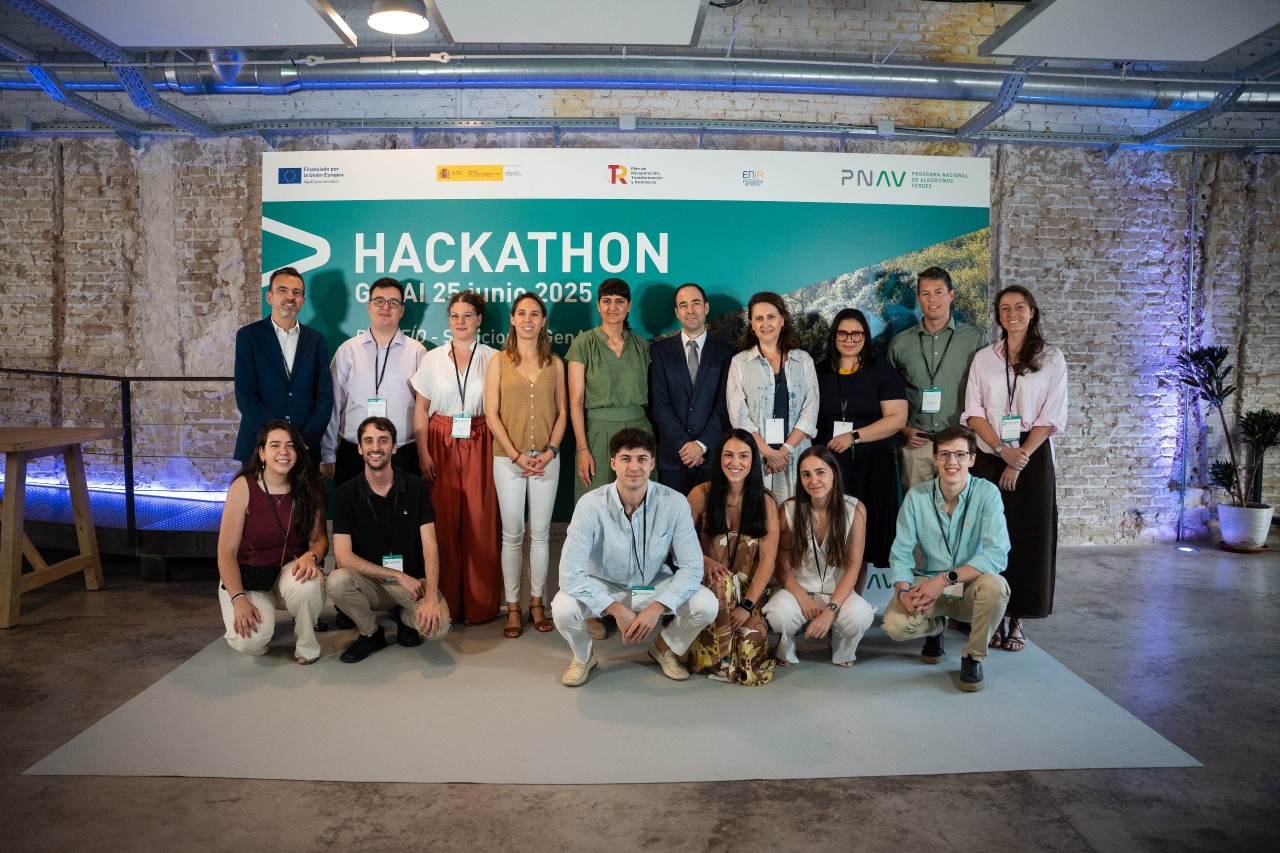
· With this collaborative meeting of developers, the Ministry for Digital Transformation and Public Service has opened a space for dialogue on the development of an ethical, sustainable and committed AI to environmental challenges.
Experts, institutional representatives and leaders of the academic and technological field have met today in Madrid in the second hackathon ‘GenAI Solutions for Biodiversity’. The conference, organized by the Secretary of State for Digitalization and Artificial Intelligence of the Ministry for Digital Transformation and Public Service, is part of the National Program of Green Algorithms (PNAV), an initiative that promotes the development of artificial intelligence solutions aligned with environmental challenges.
The Secretary of State for Digitalization and Artificial Intelligence, María González Veracruz, has opened the event highlighting the importance of this type of meeting to consolidate Spain’s position in the digital revolution: “We are a country that for the first time has a Ministry for Digital Transformation and that is much more important than you can imagine so that this type of activities have all the strength and support. Today we are promoting talent and collaborating on initiatives that show that we are doing well, because we are doing it together.” In this regard, he has argued that “the National Artificial Intelligence Strategy, which was born in 2021, has been a pioneer and has opted for a strong investment in digitization, but, above all, to anticipate to position Spain and, therefore, Europe, at the forefront of this digital revolution.”
The Secretary of State stressed that 26% of the Spanish economy is already digital and has claimed the role of artificial intelligence as part of the solution to the climate crisis: “The fight against the climate emergency is a priority for the government even before the National Artificial Intelligence Strategy. We see it as an opportunity to work for sustainable development for all.”
This approach has been key in the development of public policies that place people and the planet at the center of political action. Faced with the environmental challenges of AI, he added that “we need to educate people about their use of resources, both water and energy, because we also firmly believe that AI has to be part of the solution.”
The National Program of Green Algorithms, framed in the National Strategy of Artificial Intelligence, is articulated in two main lines: on the one hand, to promote a green, efficient and sustainable AI; and on the other, to use its capacity to optimize resources and develop solutions at the service of climate action. In this regard, González Veracruz has specified that “we are developing an EU specification to measure energy consumption, carbon footprint, water use and the performance of AI systems. More than 20 universities and companies have participated in this development, and it is led by the Secretary of State, which will include a seal of quality. Because thanks to that certification and the data we will be able to move towards a clean, green and sustainable AI.”
The chairs, allies in the responsible technological revolution
After the opening, the first table started with a debate focused on the strategic role of university chairs as a driver of sustainable innovation. In this regard, José Carlos Baquero, director of the Artificial Intelligence and Big Data Division of Secure e-Solutions at GMV, has stressed that technology is the second step: “It is essential to focus first on the problem or challenge that you want to solve in order to generate an idea of impact.” Representatives of two of the ENIA Chairs who have received assistance from the Secretary of State for Digitalization and Artificial Intelligence in the framework of the Recovery, Transformation and Resilience Plan of the Government of Spain have also participated. On the one hand, Brais Cancela Barizo, researcher at the UDC-Inditex Chair, has encouraged participants to “banish the imposter syndrome and not stagnate”, remembering that it is “a field as exciting as it is frightening, where any model from two years ago is already obsolete”, so he has insisted on the need to keep up to date. And, on the other hand, Jesús Sánchez-Oro, on behalf of the URJC-OGA Chair, has pointed out the importance of starting to experiment: “You have to lose your fear and surround yourself with people you know. This is a 100% experiential area, and sometimes those ideas that seem lost generate great results or inspire others to continue.”
With this second hackathon, the National Program of Green Algorithms advances in its objective of consolidating Spain as an international reference in sustainable technological innovation, in a cycle that will continue in the autumn with a third edition focused on new environmental challenges.