
Congress Approves Draft General Law on Telecommunications with Broad Support
27/04/2022
This law is a reform of the Recovery Plan, associated with the component “Connectivity, 5G and Cybersecurity”, which foresees an investment of 4,000 million euros to extend high-speed connectivity to 100% of the population, develop 5G and boost the cybersecurity ecosystem.
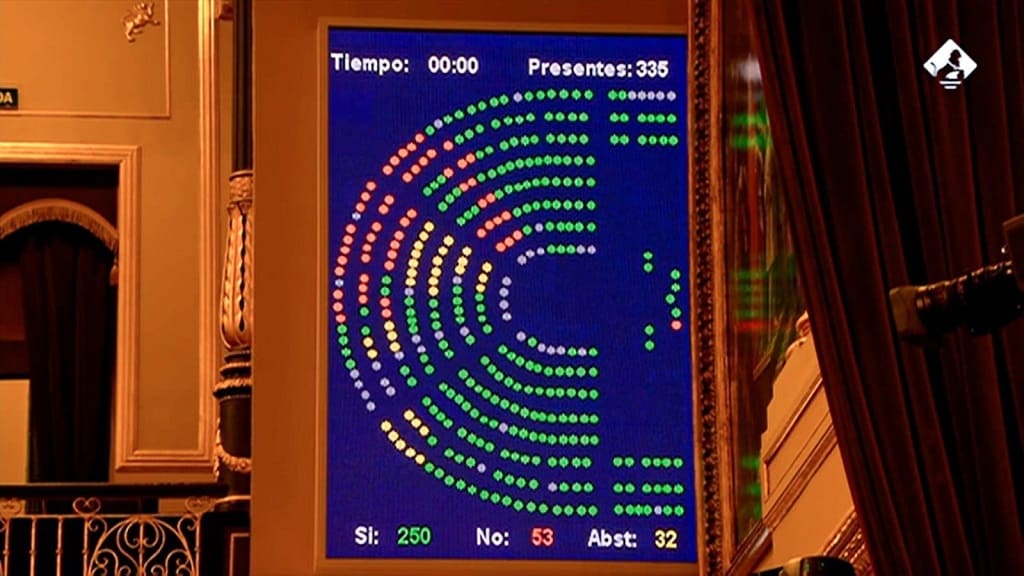
The Congress of Deputies has approved, with broad support from the parliamentary groups, the Draft General Law on Telecommunications. The legislative initiative transposes the European Code of Electronic Communications and will be forwarded to the Senate to complete its processing.
The text goes beyond the field of electronic communications networks and services to regulate, among others, aspects relating to telecommunications equipment, common telecommunications infrastructures in buildings and all uses of the public radio domain.
Main news
The bill incorporates new measures to encourage and further boost investments in the telecommunications sector, which will undoubtedly contribute to achieving the goal of guaranteeing adequate high-speed connectivity to 100% of the population by 2025.
The text introduces improvements to facilitate the deployment of very high-capacity networks such as: a more flexible regulation for co-investment agreements between operators; a boost to the sharing of passive infrastructures (antennas); the possibility of deploying low-power base stations (small cells) – so necessary for 5G – with far fewer administrative burdens; and encouraging the secondary market for radio spectrum.
In addition, the measures of the so-called Connectivity Toolbox of the European Union have been incorporated into the draft law that will allow, among other improvements, greater coordination between administrations by establishing a single point of information and processing of permits for the deployment of networks.
For the first time, interpersonal communication services independent of numbering must make a prior communication to the Registry of Operators, for statistical and census purposes. They will also need to increase transparency towards users about the conditions under which they provide their services.
In addition, the bill also establishes, for the first time, a communication regime for the installation or operation of submarine cables whose hooking, access or interconnection to electronic communications networks occurs in Spanish territory.
Likewise, a communication regime for Internet Exchange Points (IXPs) is established and information from Data Processing Centers (CPDs) may be collected.
Improvements for users
On the other hand, users' rights are strengthened and harmonised with the whole of the European Union. It improves the transparency of contracts, which must include the detailed conditions prior to contracting. Its maximum duration is limited to 24 months to allow the user to extend the contract or change the operator without penalty.
In the field of portability, new rights are also introduced for the benefit of users, such as the ability to unlock the mobile card to facilitate the change of operator; keep the prepaid balance; keep the number one month after the contract resolution and the right to free forwarding or access to emails once the contract is terminated.
The rights of users with sensory diversity are also strengthened, as the obligation of accessibility is introduced in the information relating to contracts.
The universal service is updated while maintaining the goal of providing affordable access to electronic communications. The Bill obliges to ensure that such access allows the provision of certain basic services such as e-mail; basic online training and education tools; news, social networks or internet banking, among others. In addition, the freedom of choice of the user is reinforced, who will be able to contract the social subscription to the operator he wants. The minimum broadband internet access speed is set at 10 Mbps and is expected to increase to 30 Mbps.
As far as emergency communications are concerned, free access to 112 is maintained and technical modifications are made that will make it possible to have a more precise location of the people who make a call to 112. The bill also includes the ability to implement a public alert system or 112 reverse. Thus, telecommunications operators will have to transmit public alerts in cases of major disasters or imminent or ongoing emergencies.
The General Law of Telecommunications is one of the reforms foreseen in the Recovery, Transformation and Resilience Plan. Specifically, it is part of the “Connectivity, 5G and Cybersecurity” component, which foresees the investment of 4,000 million euros to extend connectivity to 100% of the population, boost the development of 5G and boost the cybersecurity ecosystem. This is the fifth component with the greatest budgetary weight of the Plan.