
- The EDIM is a strategic infrastructure that will connect all transport information in Spain, Integrating passenger and freight data on transport, services, mobility and infrastructure, from public administrations, operators and managers, marking a milestone in the modernization of the mobility system.
- The strategy of the EDIM will establish the bases for the future development of a data infrastructure that will allow the improvement of transport services, with greater coordination between trains, planes, buses or urban, metropolitan and interurban transport, helping to reduce travel times, measure environmental impact and generate new services for citizens.
The Government of Spain presents in Madrid the strategy of the Integrated Mobility Data Space (EDIM), the road map that will define the development of a public digital instrument intended to share and connect mobility data throughout the national territory. The initiative, which will mark a before and after in the way of planning, managing and using the transport system in Spain, will be led by the Ministry of Transport, Sustainable Mobility (MITMS) in coordination with the Ministry for Digital Transformation and Public Service (MTDFP).
This event completes the process of defining the strategy of the EDIM, incorporating the conclusions and contributions collected during the public consultation held in recent months, and represents the starting point for its operational deployment and the mobilization of the mobility ecosystem around this key infrastructure.
Conceived as a country project, and foreseen in article 13 of Law 9/2025, on Sustainable Mobility, the EDIM will allow to connect for the first time all the mobility information, allowing the exchange of data of public administrations, transport operators and infrastructure managers to improve the operation of the system as a whole. With this step, Spain is at the forefront of Europe in the development of data spaces applied to key sectors, making data essential for the growth of the Spanish economy and the welfare of citizens.
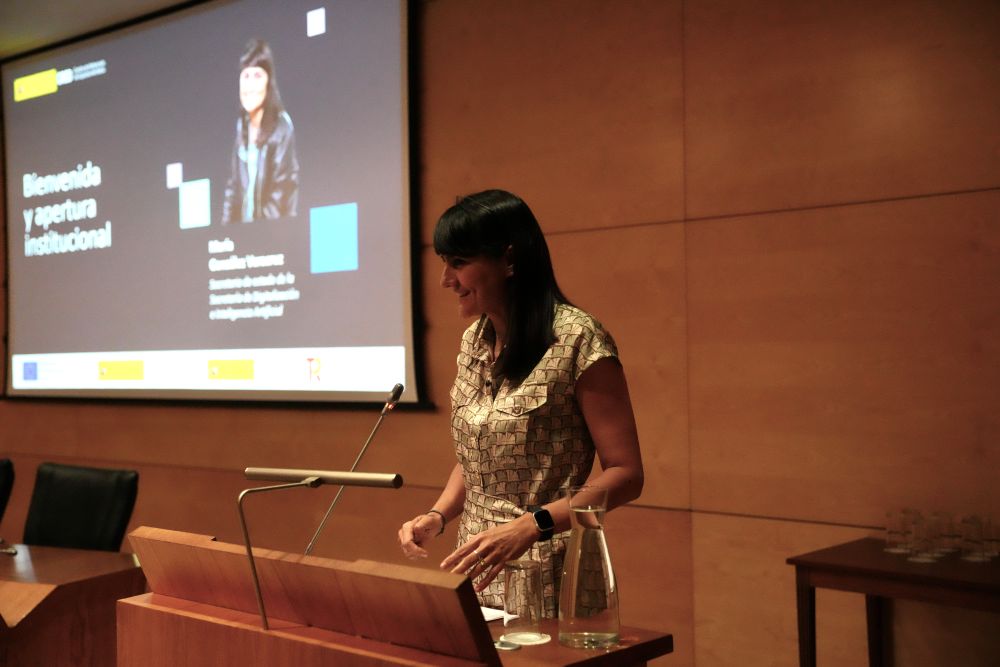
During the event, the Secretary of State for Digitalization and Artificial Intelligence, María González Veracruz, stressed that today a phase of definition, listening and joint construction is coming to an end, but another equally important phase is also beginning: that of deployment, that of turning this vision into an operational reality. This is the first step in deploying a platform that will help improve transport services, optimize travel, measure environmental impact and generate new services. In addition, he wanted to stress that today we are not only presenting a road map, but a new way of living, of taking advantage of technology to improve people’s lives through mobility.
For her part, Sara Hernández del Olmo, general secretary of Sustainable Mobility, has stressed that the mobility of the future must be increasingly sustainable, connected and intelligent, but also more integrated, accessible and people-centred. He also stressed that the strategy represents a decisive step forward in the construction of the future Integrated Mobility Data Space (EDIM), a strategic infrastructure promoted by the Ministry of Transport and Sustainable Mobility to improve public policy planning, strengthen coordination between administrations and operators and move towards a more efficient mobility system.
In this regard, he pointed out that “21st century mobility also depends on our ability to share information, build trust, interoperate systems and transform data into better public and private decisions”. He also argued that “innovation and data must be translated into real benefits for citizens”, contributing to more accessible and efficient mobility, territorial cohesion, equal opportunities and the sustainable development of our territories.
Direct improvements for the citizenship and economic fabric
Once developed and implemented, the EDIM will have a direct and tangible impact for citizens from its early stages, since it will improve the transport service, with greater coordination between trains, buses, aircraft, urban, metropolitan and interurban transport, and other means and more complete and updated information. It will also contribute to the reduction of travel times, thanks to better planning, route optimization and mobility management.
It will also provide more complete and real-time information, which will allow citizens to make better decisions on their journeys. It will drive new digital services, from smart applications to innovative, data-driven solutions tailored to each user’s needs. And it will facilitate the move towards more sustainable mobility, with reduced emissions and more efficient use of infrastructures, strengthening the efficiency and resilience of freight transport and supply chains. In short, the EDIM will allow us to build a simpler, more efficient and better adapted mobility to the needs of people.
The Division of Transport Studies and Technology, of the General Directorate of Mobility Strategies of MITMS, together with the Data Space Reference Center (CRED), a unit belonging to the General Directorate of Data, within the State Secretariat of Digitalization and Artificial Intelligence in the MTDFP, have carried out the analysis of the mobility ecosystem, the definition of the strategic model and the design of an initial roadmap for the elaboration of the strategy of the EDIM. In addition, a process of public participation has been opened, the results of which have allowed the final version of the strategy to be adjusted and consolidated, incorporating the contributions of the public and private ecosystem.