· ALIA 40B Instrucido has trained with 40 billion parameters adapted to Spanish sociocultural characteristics to help ensure that cultural and linguistic diversity is represented in the AI
· María González Veracruz: “ALIA is an open project, a continuous process in which experience, research, training and new knowledge are added”
· Six demonstration centers have participated in the meeting that have developed use cases on language models and resources of the ALIA family, related to areas such as legal, attention to citizenship, emergency management or news verification.
· In addition, as a closure of the National Program of Green Algorithms, a ‘message-a-thon’ has been developed in which more than 30 finalists from all over the territory have interacted with ALIA to contribute to a more responsible energy consumption
ALIA 40B Instrucido is already at the disposal of the Spanish artificial intelligence ecosystem. The new language model that it provides ALIA, a public infrastructure promoted by the Ministry for Digital Transformation and Public Service, has been trained with 40 billion parameters and is able to interact with an interlocutor, compared to 7,000 in the previous version. In addition, this model has been aligned and instructed with a set of data and instructions adapted to the sociocultural characteristics of Spain, combining contributions from human translators and supervised synthetic generation. With this, ALIA 40B Instruido helps to ensure that the cultural and linguistic diversity of the whole of Spain is represented in AI developments.
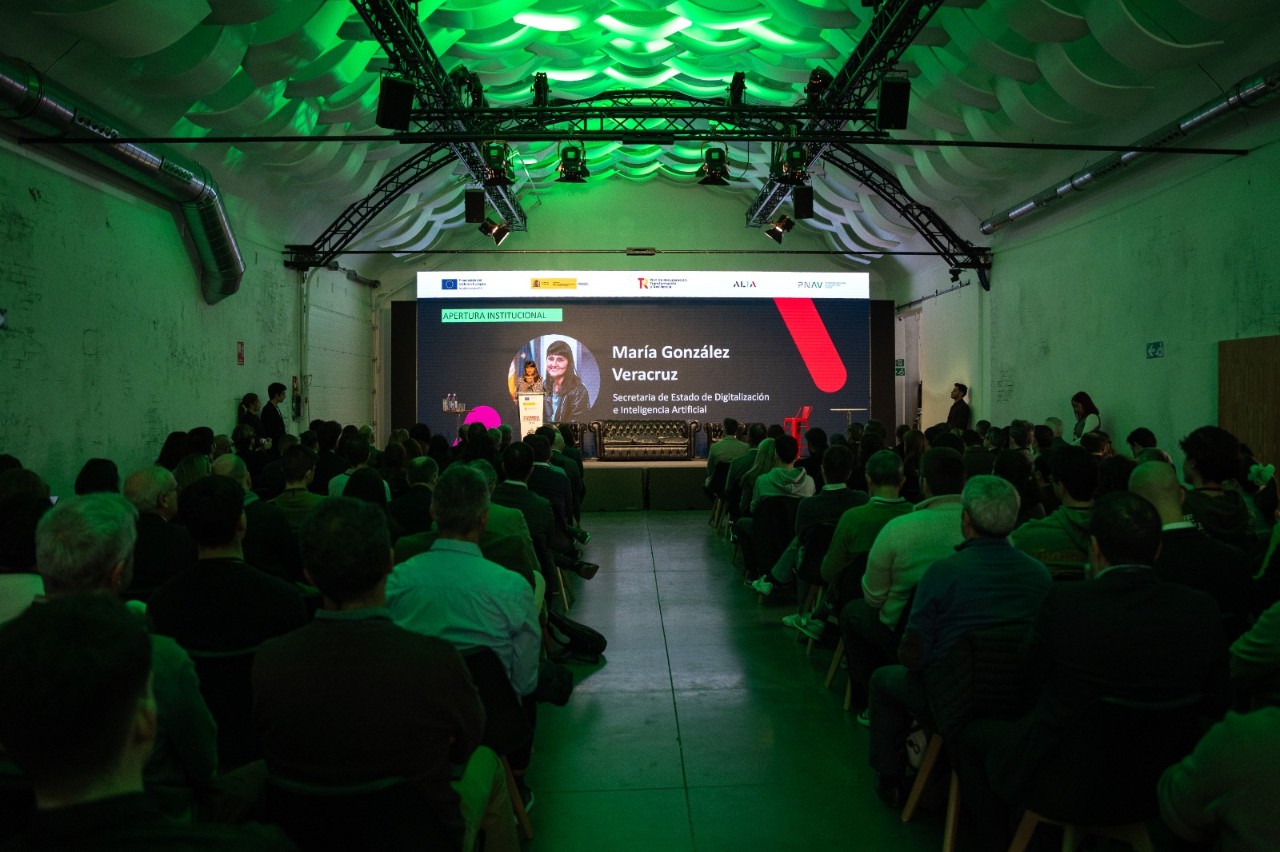
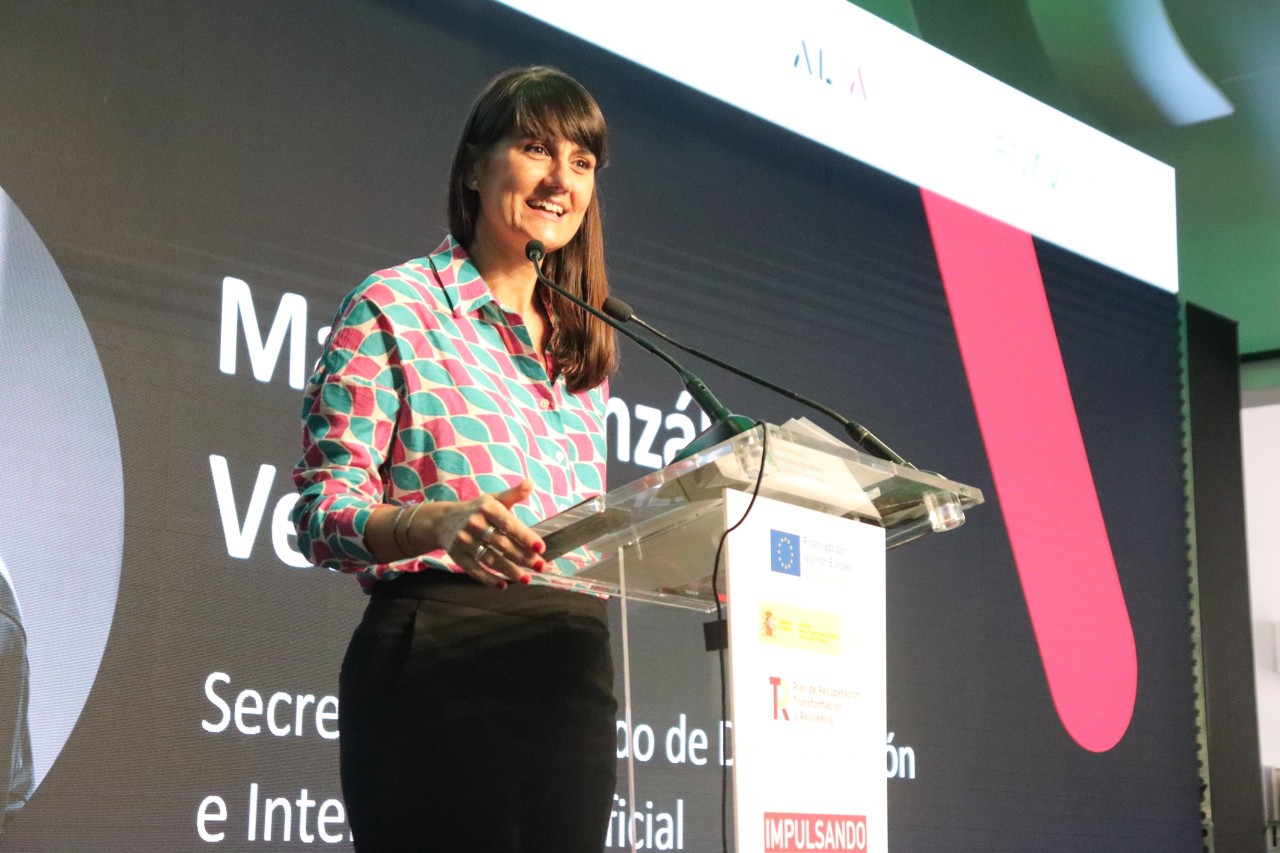
This was announced today by the Secretary of State for Digitalization and Artificial Intelligence, María González Veracruz, at the opening of the conference ‘Driving the AI ecosystem’, which hosted the end of the A-Thon ‘ALIA Challenge’, the first activity of the Open Source AI Community recently launched from SEDIA. The meeting, framed in the National Program of Green Algorithms and organized by the General Directorate of Artificial Intelligence, has raised an extensive dialogue on how to build a more responsible, efficient and sustainable AI, as well as the end of a a-thon in which more than 30 participants from all over the territory, of the 91 registered, have proposed AI solutions that contribute to a more responsible use of energy resources, applying the ALIA 40B Instructed model.
According to the Secretary of State, “from our public responsibility and always within the framework of defending our values and the rights of the people, what we wanted and what we want with ALIA are two things: strengthening our sovereignty and boosting our talent. We were the first to provide a public and open infrastructure of AI resources and now we are followed by other countries. The European Commission itself takes us as inspiration for Open Europe LLM.”
“The challenge we have put forward today shows that ALIA’s path continues. It is an open project, a continuous process in which experience, research, training and new knowledge are added, and which constantly publishes improvements. And on this path, it is generating opportunities for the ecosystem,” said González Veracruz.
The ALIA family of language models started last January with the base model 40B, on which it has been built. In the following months, the Roberta Multilingual model was published, capable of analyzing and classifying information in several languages, and the Salamandra 7B model, an automatic translation system that works with all the official and co-official languages of the State and with those of the European Union.
ALIA in action
The event has had a demonstrator space in which public and private entities have presented initiatives in which ALIA and other models developed within the framework of the ILENIA program are already being implemented. Thus, the attendees have been able to know at first hand the potential of the models to improve efficiency, accessibility and sustainability in different areas such as legal, attention to citizenship, emergency management or news verification. The six demonstration centers offer a variety of innovative applications that are positively impacting information management, decision-making and improving public services.
Towards a Spain referent in green AI
Throughout the day, which was attended by a hundred participants, a cycle of discussion tables has also been held in which experts in technology, ethics, sustainability and public policies have analyzed the social and environmental impact of AI, seeking to strengthen collaboration and learning among the main actors of the Spanish ecosystem. The program began with the intervention of Cristian Cantón Ferrer, associate director of the Barcelona Supercomputing Center (BSC), which has highlighted the Government’s commitment to the development of the country’s first AI Factory to democratize access to this infrastructure, strengthen its application for the benefit of the public interest and reduce linguistic and cultural gaps in the digital sphere.
The first panel focused on how AI has become a strategic issue for the technological sovereignty of countries, exploring the measures that Spain can adopt to position itself at the forefront of innovation. In this context, special attention has been paid to the UNE standard, which establishes criteria for measuring and optimizing the energy consumption of algorithms. Noelia González, head of AI at the European University; Senén Barro, director of the Singular Research Center on Intelligent Technologies (CiTIUS) of the University of Santiago de Compostela; Iraia Ibarzabal, CGO of Multiverse Computing; and Rafael Muñoz Guillena, president of the Spanish Society of Natural Language Processing (SEPLN) and general secretary of the Digital Intelligence Center (CENID) of the University of Alicante, participated.
To continue, Nerea Luis, doctor in AI and co-founder of Lumi Labs; María Grandury, founder of Somos NLP and researcher at the Polytechnic University of Madrid (UPM); Carlos Riquelme, principal scientist at Microsoft AI; Nuria Ávalos, general director of IndesIA; and Eduardo Ordax, GenAI Lead EMEA of Amazon Web Services, have led a debate on the current state of AI, addressing both the value that is already contributing to its technical challenges. The exchange of views between academia, the private sector and large technology companies has allowed us to offer a realistic look at the current and future impact of AI.
The third and last table has been dedicated to the incorporation of artificial intelligence in the public administration, presenting real cases already in operation. Enrique Ávila Gómez, director of the Artificial Intelligence Reference Center of the General Staff of Defense; Aitor Cubo, general director of Digital Transformation of the Administration of Justice; Manuel Perera Domínguez, general director of Digital Strategy of the Digital Agency of Andalusia (ADA); and Mariví Monteserín Rodríguez, mayor of the City of Avilés participated in this session, where they highlighted their contribution to the efficiency of public services.
After the closing of the day by the general director of Artificial Intelligence, Aleida Alcaide, the winners of the challenge have been revealed. The winners have been selected based on the quality of the interactions with the model and the efficiency in the use of the ‘prompts’ registered on the platform. The first prize was awarded to Sara Khiar Souri and Víctor Humberto Casanova Bernal; followed in second place by Juan Linares Lanzman; and the third prize was awarded to David Durán Olivar and Emiliano Javier Castro. The goal of both challenges was to achieve valid and logical responses, using as little computation as possible in the responses, to achieve maximum energy efficiency.