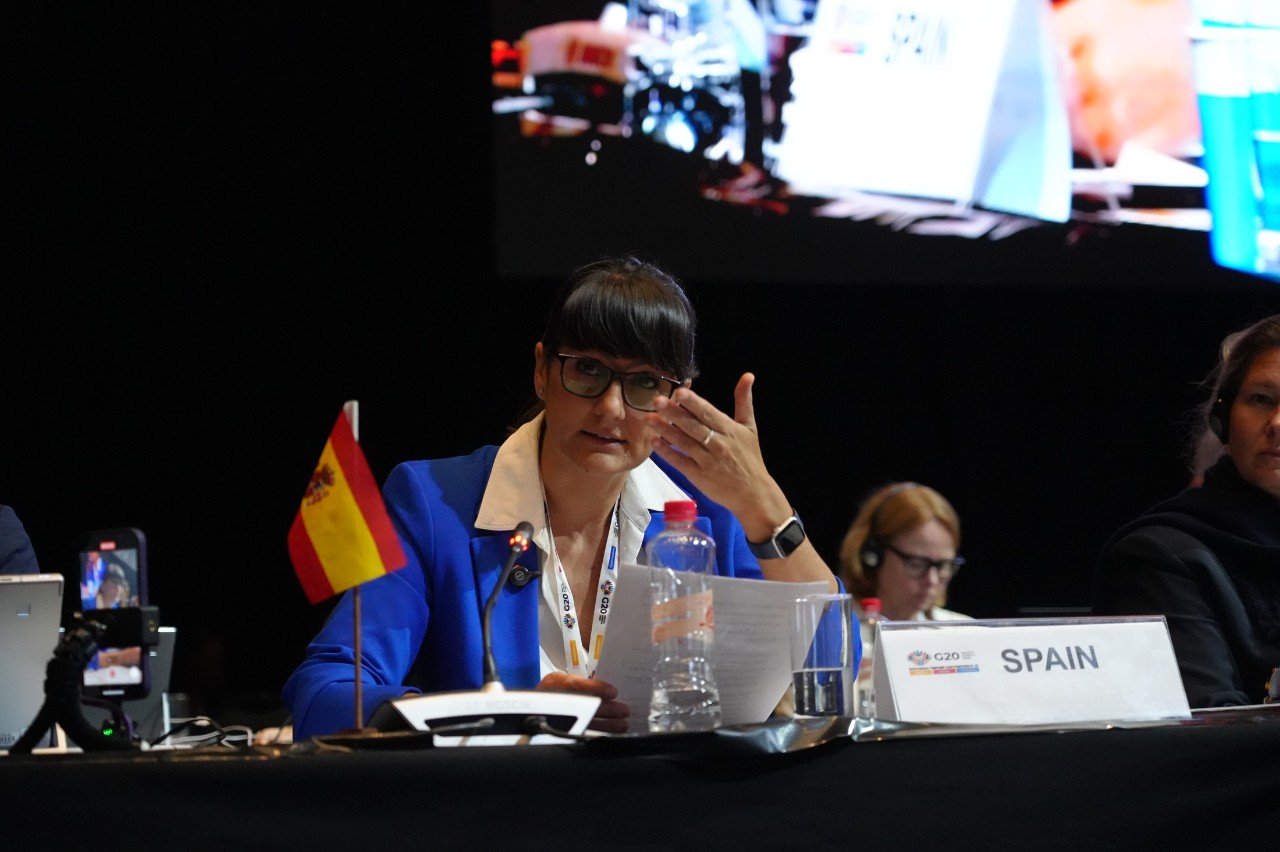
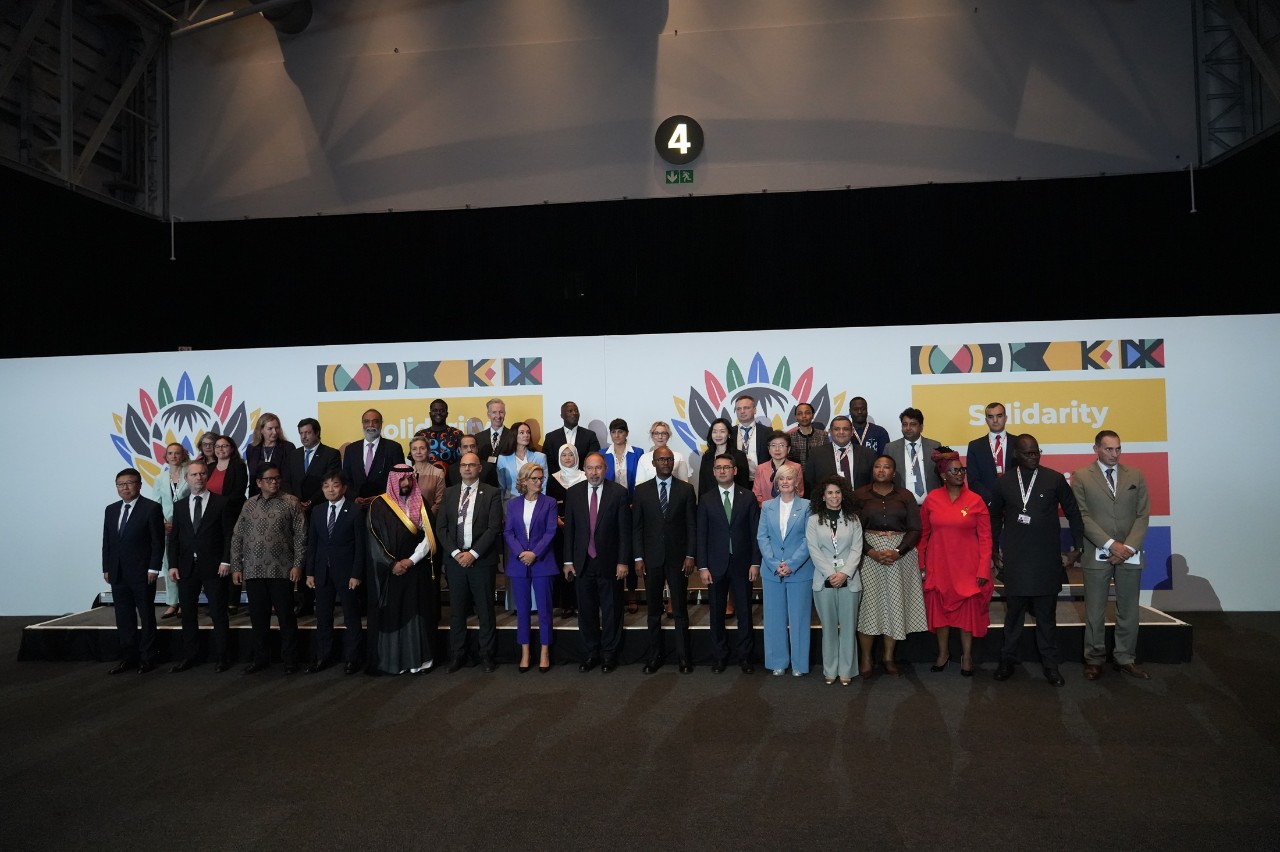
Spain continues to defend the values of multilateralism in the global governance of Artificial Intelligence in the main international forums. In line with the approach taken last week by the President of the Government at the United Nations, the Secretary of State for Digitalization and Artificial Intelligence, María González Veracruz, spoke today at the first ministerial meeting on AI, Data Governance and Innovation for Sustainable Development (Ministerial Meeting Taskforce on AI, Data Governance and Innovation for Sustainable Development) of the G20, held in Cape Town (South Africa).
At this meeting, González Veracruz explained that “Spain advocates and is ready to work for a global governance of Artificial Intelligence, in which the States, but also experts, companies and citizens participate”. “We want to develop its potential and turn it into a vehicle for innovation, competitiveness and social cohesion. But we also want to mitigate its risks and safeguard people’s digital rights,” he said. And, therefore, it has called for “protecting personal data and intellectual property if we want both the economy and citizens to trust AI.”
Before an audience composed of ministers and secretaries of State from 35 countries, as well as leaders of the main international organizations, the Secretary of State explained that “Spain’s proposal combines a humanistic perspective and a strong commitment to the public-private alliance.” In this regard, it has detailed the initiatives promoted by the Government of Spain within the framework of the Artificial Intelligence Strategy, which mobilizes 1,500 million euros to position Spain as a reference in ethical and responsible AI.
Among them, he mentioned the impulse of Spain the European regulation of AI during the Spanish Presidency of the Council of the EU, being the first international regulatory standard in this field; the adoption of the Charter of Digital Rights and the creation of the Digital Rights Observatory; the launch of the ALIA language model, a public and open model that prioritizes training in Spanish and co-official languages; the opening of the ALIA community in order to produce tangible solutions for the SME challenges; the choice of the Barcelona Supercomputing Center as one of the seven factories of IT.
With all this, González Veracruz has advocated that Artificial Intelligence is at the service of people, science and the economy. Thus, he considered that “Spain wants to support the construction of a local ecosystem of AI and public infrastructures so that AI can support development cooperation, as established by the Seville Declaration on Financing for Development”.
As he recalled in his speech, “Spain has been the first European country to place the AI debate at the United Nations, co-facilitating the first consensus resolution in the global dialogue on AI governance and an AI scientific panel.” To this end, it has made a voluntary contribution of 3 million euros, choosing Valencia as the headquarters of the AI for Humanity Lab, linked to the UN Office for Digital and Emerging Technologies, “turning this city into a hub of innovation and multilateral cooperation.” In this regard, the President of the Government has already offered that Spain host the first meeting of the United Nations Scientific Panel on AI.
He concluded, “We have a responsibility to ensure that AI serves people, respects rights and supports a sustainable future for our nations and our planet. For this, multilateralism is key and necessary.”
Cooperation with Africa
Also on her visit to Cape Town within the framework of the G20 South Africa, the Secretary of State participated in the ‘AI for Africa’ summit, where she intervened to bet on the Spain-Africa Strategy 2025-2028 as a way to explore together how to reduce the digital and connectivity gap because, without it, AI cannot grow. For this, according to the Secretary of State, it is necessary to mobilize resources as the European Union, “to empower African talent and make AI a vehicle of prosperity. This is a great opportunity to work together on tools to build capabilities, infrastructure and governance frameworks for AI,” he said. In addition, it has held bilateral meetings with its counterparts in South Africa and Brazil.
Spanish SMEs in the ICT Challenge
In addition, the Secretary of State has held a meeting with the three Spanish companies that, with the support of the Ministry for Digital Transformation and the Public Service, have participated in the Digital Innovation Challenge for SMEs (ICT Challenge), promoted by the South African Presidency of the G20 to value digital transformation and cross-border collaboration in the global ICT landscape.
This is AnySolution, which has participated in the category ‘Digital platforms and AI tools’, a company based in Palma de Mallorca, which develops intelligent solutions oriented to the digital transformation and sustainability of tourism, combining the use of technologies such as AI, IoT and data analysis; Cyclick, in the category ‘Circular economy’, a company from Malaga and with delegation in South Africa, oriented to promote sustainable and inclusive access to technology through device reconditioning; and Quibim, which has concurred in the category ‘Innovations for health development’, a company with headquarters in Valencia specializing in biomedical analysis and applied precision.