The Data Office dynamizes the national ecosystem of data spaces
14/09/2022
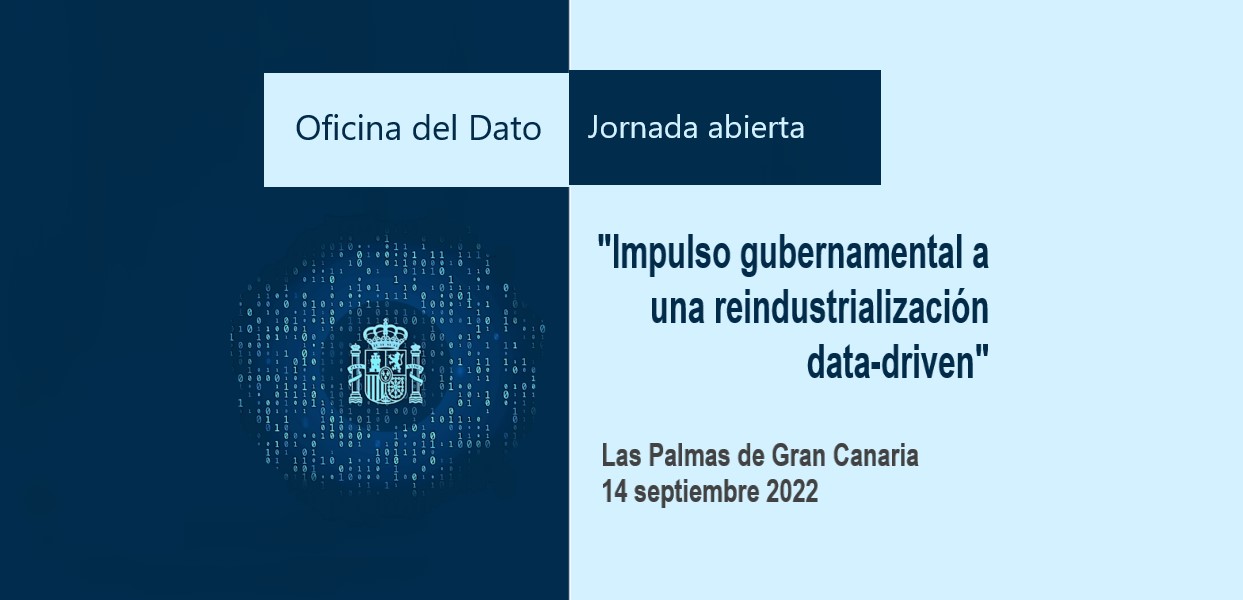
The day, held in Las Palmas de Gran Canaria last September, contextualized the current moment of data spaces, delving into the architectural reference models and different building blocks available, as well as their specification to the tourist area.
Development of an interoperable data infrastructure at country level
Today in Las Palmas de Gran Canaria the open day ‘Government impulse to a data-driven reindustrialization -Data space of Spanish Tourism’ was held, organized by the Office of Data, dependent on Secretary of State for Digitalization and Artificial Intelligence. The event has also counted on the participation of Hub Gais-X Spain, National Representative of the Pan-European Initiative for an Open and Sovereign Federated Data Infrastructure.
It has been a meeting between entities and companies from various sectors, with the aim of dynamizing and generating synergies in the national ecosystem of data spaces. Likewise, the Tourism has had a central role, thanks to the benefits that these innovative paradigms offer to an industry with strong intersectoral interdependence, and for which federated architectures propose a self-scalable solution from design. For this reason, the conference has also served as a starting point for the design of its data space, which also serves as methodological support for those of other sectors.
The day of this Wednesday began with a presentation of the Chief Data Officer, Alberto Palomo, where he formulated a common definition of what a data space is and offered the European context and history. Next, he recapitulated government investments for demonstration projects, focusing on support from the Data Office, where the deployment of a horizontal data and services infrastructure is designed and coordinated to promote the digital transformation of the country's industries.
After the Chief Data Officer, Enrique Serrano, member of the Board of Directors of Gais-X Spain, explained the structure, the organizational model and the lines of work of the Hub. The purpose of this initiative is to give form to open and transparent ecosystems for the sovereign sharing of data in sectoral areas, and which - built on the aforementioned common infrastructure - serve to deploy data-driven initiatives. With this, Spain also aspires to lead data spaces in strategic sectors such as Health and Tourism.
He also counted, as a guest of honor, with Francesco Bonfiglio, CEO de Gaia X AISBL (the European Central Association), which gave a few words in service of contextualising the current framework of data spaces and the role of the Gaia X initiative in that framework.
Tourism, a key sector in the digitalization of the national productive fabric
The objective of the day was to dynamize and generate synergies in the national ecosystem of data spaces, stimulating networking between entities and companies in order to create a common road map and generate proposals of industrial value.
In particular, the momentum generated during the day is expected to follow a prompt practical application in the tourism sector. For example, through the development of pilot use cases, which will be the ones that shape the first version of the Spanish Tourism dataspace. These will be addressed in the form of a workshop, to be carried out in the near future in collaboration with the Secretary of State for Tourism, through SEGITTUR.
Dolores Ordoñez, director of the Spanish company AnySolution and leader of the DATES project, selected to lay the foundations of the dataspace European of Tourism, has established the strategic priorities of the sector, and articulated the predominant leadership role that Spain is playing in the international context. In this section, we could also count on the experience of Aday Hernandez, from the Department of Technological Development and Innovation of Satocan, a Canarian business group that has been working for several years in the digitalization of its business processes.
On the other hand, the General Director of IndesIA, Nuria Ávalos, the President of the Cloud Commission and the Gaia X Working Group of Ametic, Jorge Morillo, the Coordinator of the Proyecto ‘Gran Canaria Isla Listo’ of SODETEGC, Víctor Álvarez, and the Minister of Digital Transformation in the Permanent Representation of Spain before the EU (REPER), Carlos Romero, addressed the incentives and regulations for the sovereign sharing of data, including between private organizations (Business-to-Business).
Later, also Alejandro Banegas (VP and Director of Business Development of MasterCard) together with Tomás Morales, (Chief Digital Officer of AdQuiver), and the Director of Industry Affairs for EMEA at Amadeus IT, Juan-Jesús García, illustrated different types of tourism use cases, where novel problems are solved based on data sharing. Finally, Alejandro Cosa, Engineer of R&D in the ITI (Technological Institute of Informatics) introduced formulas for data management, quality and experimentation, a nuclear issue in order to generate latent value based on large data sources.
They are different perspectives that have allowed us to focus the design of the ‘dataspace nacional’, with which to launch specific use cases. By design, these projects will be able to share (sovereignly and securely) data sets, capitalize on common methodological and technological resources among them, and even take advantage of the lessons learned from different organizations, which, during the session, shared their practical experiences.
A convergent architectural framework at European level
The last block of the event, of architectural scope, has been focused on the dissemination of reference models and ‘building blocks’ for the sovereign sharing of data. The Director of Innovalia, Óscar Lázaro, the Coordinator of the IDS Competence Centre in Tecnalia, Alberto Berreteaga, and Adrián González, Senior Cloud Specialist, Data & AI for Public Sector of Microsoft, have exposed the characteristics and some typical applications of the International Data Spaces (IDS-RAM) model, on which numerous pilot projects have been deployed throughout the European geography.
On the other hand, Juanjo Hierro and Jesús Ruiz, respectively Chief Technology Officer and Blockchain/DLT Lead at the FIWARE Foundation, together with Clara Pezuela (Innovation & Business Developer and Scientific & Expert Communities member in Atos) told us some keys about the process of technological convergence in full development within the Data Spaces Business Alliance, as well as the degree of progress towards a Minimum Viable Framework for interoperable data spaces based on a decentralised identity model.
The day was held within the framework of the FIWARE Global Summit 2022, which is hosting various sessions related to dataspaces. These serve to reinforce the context and message of this day of impetus to the national ecosystem. La Economy of Data It is one of the priorities of the digitization project of Spain and the EU. Among the objectives at European level is to become the leader of a data-driven society, relying on a digital single market where data is freely shared (respecting sovereignty) between member countries.
To this end, the European Data Strategy was launched, whose pillars are the development of governance frameworks for access and multisectoral use of data, the empowerment of citizens and companies around them (both through training, autonomy and rights over the use that others make of them), the deployment of computer technologies and digital infrastructures, as well as the creation and evolution of common and interoperable industrial data spaces.
La Economy of Data It has an increasingly important role in European productive ecosystems. It is estimated that -in 2025-it will mean 4% of the GDP It will generate values in excess of EUR 50 billion, employing 750,000 workers (European Data Market study).
Link to the recording on YouTube