
Spain works at national and European level for the interoperability of infection prevention applications against COVID-19
05/05/2020
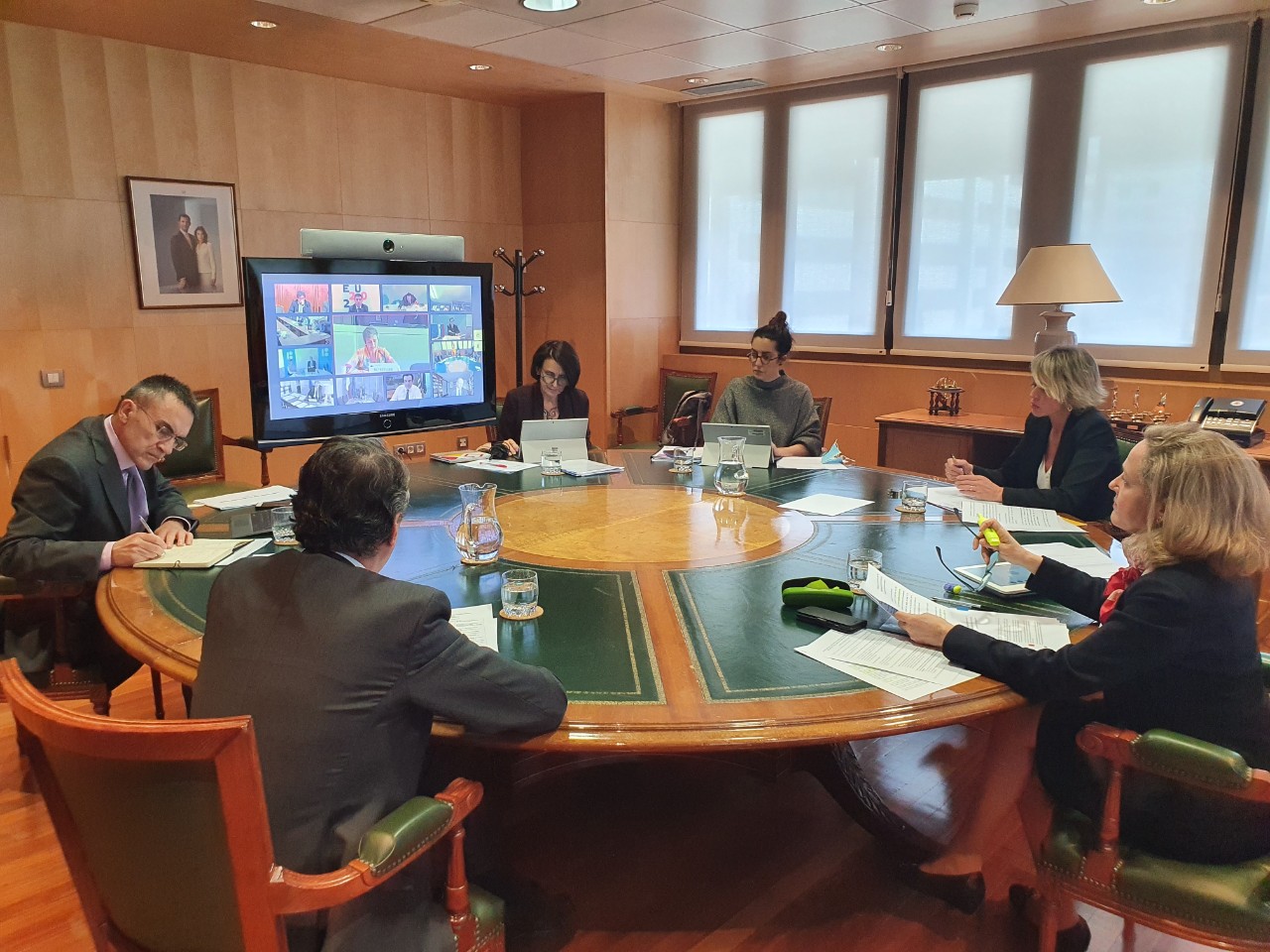
Spain is working at national and European level for the interoperability of infection prevention applications against COVID-19 that contribute to the transition towards a new normality.
May 6, 2020. Spain is working at national and European level for the interoperability of infection prevention applications against COVID-19 that contribute to the transition to a new normality.
This was reflected in the meeting of the informal European Council of Telecommunications Ministers that took place yesterday to address the implications of the health emergency in the digital and telecommunications sector.
The Third Vice-President of the Government and Minister of Economic Affairs and Digital Transformation, Nadia Calviño, together with the Secretaries of State for Digitalization and Artificial Intelligence, Carme Artigas, and for Telecommunications and Digital Infrastructures, Roberto Sánchez, participated in this meeting to seek a common European position that allows us to take advantage of the possibilities offered by technology to contribute to the management of the pandemic and to the subsequent recovery at European level.
Among these digital solutions, the focus was on infection prevention applications. In this regard, Spain stressed the importance of finding a coordinated approach at European level for these applications that guarantees interoperability and allows a joint exit from the health emergency.
In addition, it was pointed out the need to take advantage of the potential offered by the digital economy to contribute to the management of the pandemic, being necessary to find a balance between the benefits derived from these innovations and privacy, security and ethical issues.
Working group at national level
Also held yesterday was the first meeting of the national working group on mobile infection prevention applications, mainly focused on interoperability protocols.
The Secretary of State for Digitalization and Artificial Intelligence, Carme Artigas, shared with the autonomies the position of Spain at European level, as well as the advances that the European Commission is preparing on these digital tools.
The objective is to join efforts and share views on the possibilities existing around the development of these applications and their interoperability, seeking coordinated responses based on the needs of the different territories.
In this first meeting, the existing models, the challenges and the opportunities they present, as well as technological and epidemiological issues that are necessary for the model to be implemented to meet the needs of citizens and health authorities, have been analyzed. Therefore, the creation of specific working groups on functionality, privacy and interoperability has been agreed.
Spain’s position on digital contagion prevention tools aligns with that of the European Commission and the European Data Protection Committee that advocate the implementation of a voluntary use model, compatible with the General Data Protection Regulation, focused on the protection of people’s privacy, and interoperable at a cross-border level.
The representatives of all the CCAA in terms of digitalization, digital transformation or innovation policies have shared the autonomous developments and their vision of the need to incorporate these technological tools in the process of transition to the new normality.
Tool for the de-scaling process
Infection prevention applications can become a useful and complementary tool to health measures for the de-escalation process.
The operation is based on the installation of an application on mobile devices that, through Bluetooth, emits and observes anonymous identifiers that change periodically. When two mobiles have been in proximity for a certain period of time, both keep the anonymous identifier issued by the other and, if a user tests positive in the COVID-19 test, it is possible to alert the mobiles that have been in contact, always preserving the privacy of the individuals.
These digital systems that are being considered at European level use the Bluetooth of mobile devices, without using personal data and respecting the privacy of citizens.
In this way, it is possible to have a digital infection prevention tool that complements manual actions and contributes to the transition to a new normality.
The adoption of these tools will depend on the decision of the health authorities based on the results of the pilot projects that can be launched in the coming weeks.