
The program “Cátedras Chip” is committed to the training of talent in microelectronics by subsidizing university expenses and promoting equal opportunities
13/07/2024
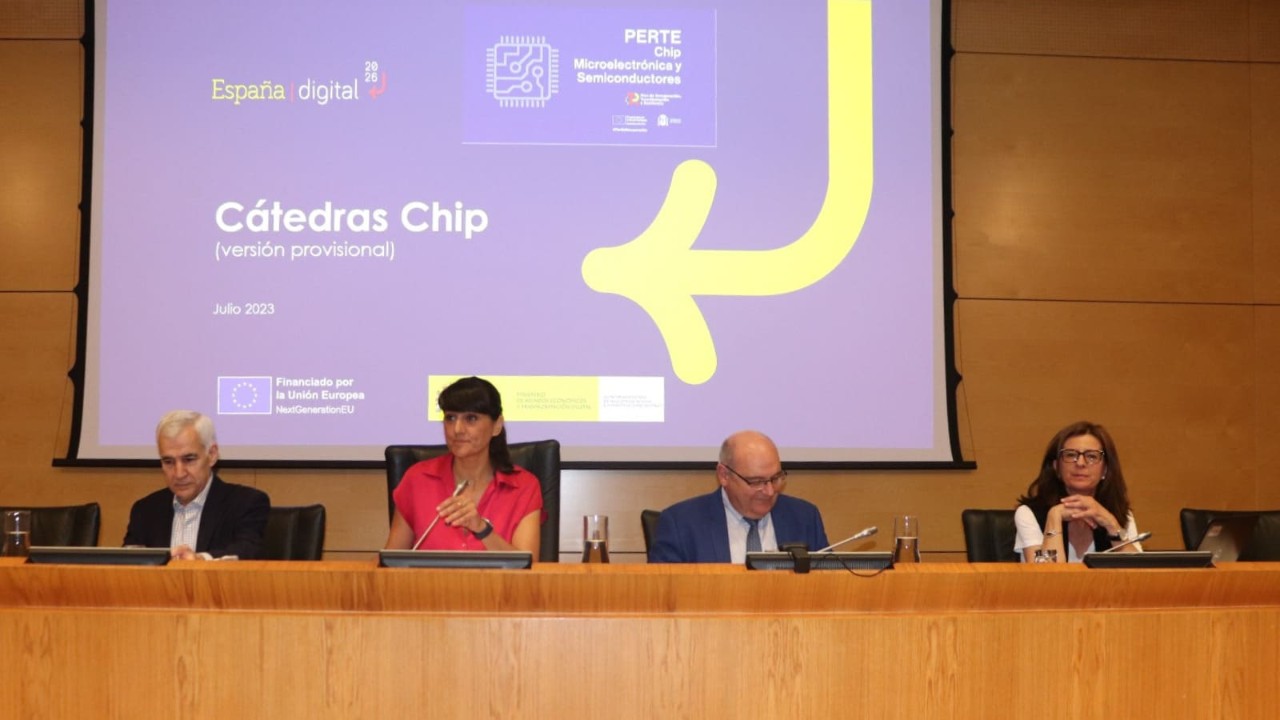
The Secretary of State for Telecommunications and Digital Infrastructures has participated in the 2nd seminar ‘Cátedras Chip’, aimed at promoting university-business collaboration to expand the offer of higher studies in microelectronics. This program seeks to promote equal opportunities for students to access training in microelectronics and semiconductors, so the funding of university expenses has been included in the grant. More than 300 representatives of Spanish companies and universities have been interested in the program, attending face-to-face and virtually the sessions held.
The Secretary of State for Telecommunications and Digital Infrastructures, María González Veracruz, has participated in the 2nd informative seminar on the Chairs Chip program, aimed at the creation of university-company chairs aimed at research and development in the area of microelectronics for the dissemination of knowledge and training, within the framework of the European Recovery, Transformation and Resilience Plan, financed by the European Union with the funds Next Generation EU.
González Veracruz opened the session by welcoming the more than 150 attendees and highlighting the importance of betting on the training and retention of talent in Spain. Next to him were the Secretary General of Universities, José Manuel Pingarrón, and the Special Commissioner for the PEARL Chip, Jaime Martorell, who stressed the relevance of the Program. Finally, Elena Benítez has detailed the characteristics of the program, which will soon be launched.
This program is endowed with 80 million euros, which are requested in two subprograms: one for public universities, and another for private ones. In this way, it is intended to finance the largest possible number of university-business chairs, as well as to ensure that at least 1,000 students have access to specific high-capacity training in the area of semiconductors and microelectronics.
In the information day it has been announced that, if the chair has a high international component, the endowment to the project would be increased, thus seeking to promote collaboration with renowned researchers, international institutions, or similar.
With the aim of eliminating the economic barriers to access to talent, this program not only includes the financing of all expenses of the newly created chair, but also, in the case of public universities, will cover, among others, university training expenses for students of degrees, doctorates and own degrees.
As María González Veracruz has highlighted, talent is what makes Spain a world reference in a sector as key as microelectronics, but also the country’s greatest need to maintain and improve that positioning. Therefore, it has launched an appeal to companies and universities for their cooperation and collaboration, with a view to making the Program a success.
The publication of the bases that regulate the program and the call for aid will be published next fortnight in July, which will start the deadline for submitting applications. In this way, it is expected that the delivery of funds to the beneficiaries can be made before the end of the year.