
González Veracruz encourages studying telecommunications engineering “because it is a key sector in the digital age and has full employment”
07/11/2023
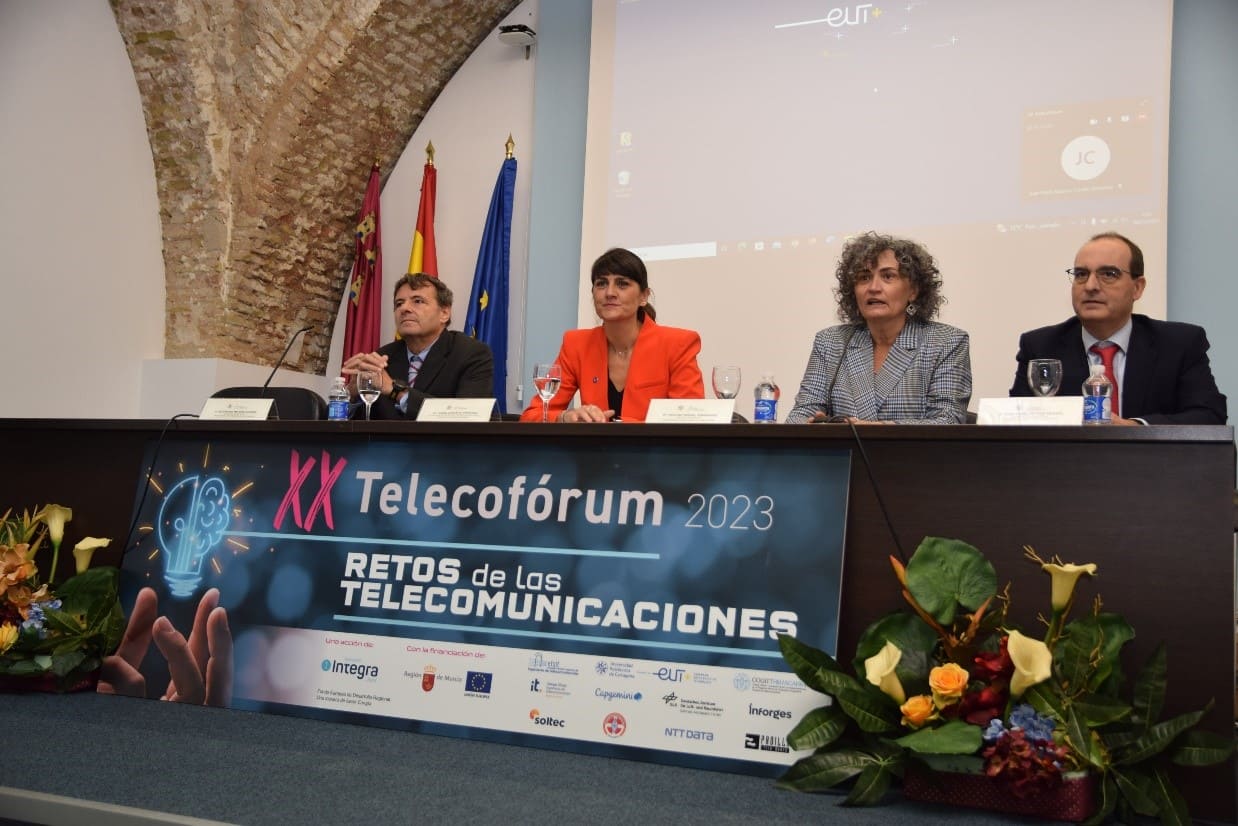
The Secretary of State for Telecommunications and Digital Infrastructures in office, María González Veracruz, together with the Magnificent Rector of the Polytechnic University of Cartagena, Beatriz Miguel Hernández, and the director of the Superior Technical School of Telecommunications Engineering of Cartagena, Alejandro Melcón Álvarez, has inaugurated the 20th edition of the ‘Telecofórum Cartagena’. An event aimed at students in which different specializations of this engineering have been deepened with references in research and development, data analysis, radio frequencies, aerospace systems, electronics and software, cybersecurity and new digital technologies.
The Secretary of State for Telecommunications and Digital Infrastructures in office, María González Veracruz, together with the Magnificent Rector of the Polytechnic University of Cartagena, Beatriz Miguel Hernández, and the director of the Superior Technical School of Telecommunications Engineering of Cartagena, Alejandro Melcón Álvarez, has inaugurated the 20th edition of the ‘Telecofórum Cartagena’. An event aimed at students in which different specializations of this engineering have been deepened with references in research and development, data analysis, radio frequencies, aerospace systems, electronics and software, cybersecurity and new digital technologies.
González Veracruz has encouraged the development of a training and professional trajectory in telecommunications, stating that “studying teleco engineering is profitable because of the very high employability, both in the private and public sector, and because of its salaries above the average”.
In front of a Degree Hall of this Technical School full of students, he has invited them to know and get involved in the different activities promoted from the portal ‘Teleco Renta’ with which the Government of Spain, through different Universities, has promoted for the promotion of studies in this engineering. And he stressed that “currently there is four times more demand for skilled jobs in digital skills than existing supply, and more than 20% of contracts are generated in digital and scientific jobs since the approval of the Labor Reform. Data that show the productive change that is being key for Spain to exercise at this time of European economic locomotive”.
He stressed that “our country is leading in Europe the indicators of digital infrastructures as has been verified in the last Report of the Digital Decade, we lead the deployment of fiber in the EU placing us 35 points above the EU average. In addition, we are the first of the large European economies to cover very high-capacity networks; 82% of the population already has 5G coverage, and we have 98% of Spectrum allocated exceeding the European average by 30 points.”
“Spain is already digital and the government’s public investment is guaranteeing equal opportunities throughout the territory. In the Region of Murcia we have allocated more than 30 million euros for the deployment of fiber and we are going to invest around 5 million euros in the early deployment of 5G in municipalities of less than 10,000 inhabitants. It is the great historic opportunity for the Region to take advantage of its potential in this new digital era and our universities are key to this.”
Congratulations on 25 years of UCT and involvement in the PERTE Chip
The acting Secretary of State has also taken the opportunity to congratulate the Polytechnic University of Cartagena for the celebration of its 25th anniversary. He has valued “the great tradition in Cartagena for many decades in promoting higher studies in economic and technological matters, and the great value that this Polytechnic University represents for the Region”.
In view of this, it has encouraged the UPCT to become involved in PERTE Chip training projects that seek to train engineers specialized in microelectronics and semiconductors. El del Chip is one of the twelve Strategic Projects for Economic Recovery and Transformation (PERTE) that the Government of Spain has promoted for the diversification and modernization of its economic sectors. Driven as an opportunity after the microchip supply crisis a couple of years ago, it aims to consolidate in Spain an ecosystem around the design, development and manufacture of these semiconductors.
González Veracruz has deepened the actions at all levels that are being carried out in this Project through the State Society of Microelectronics and Semiconductors (SEMyS) and the State Secretariat for Telecommunications and Digital Infrastructure. He pointed out that “to implement an almost unprecedented ecosystem in our country we are going to take advantage of the European Funds, mobilizing more than 12 billion euros. We want to gain in digital sovereignty and generate more qualified employment in Spain, promoting national talent and attracting investments such as those recently announced by multinationals such as Cisco, Intel or Intel. Broadcom”.
Finally, he highlighted “the capacity of synergies of this project with the Polytechnic University of Cartagena, which has as a great guarantee the high added value that it is contributing to the regional industry and the great capacity of labor insertion of its students”.