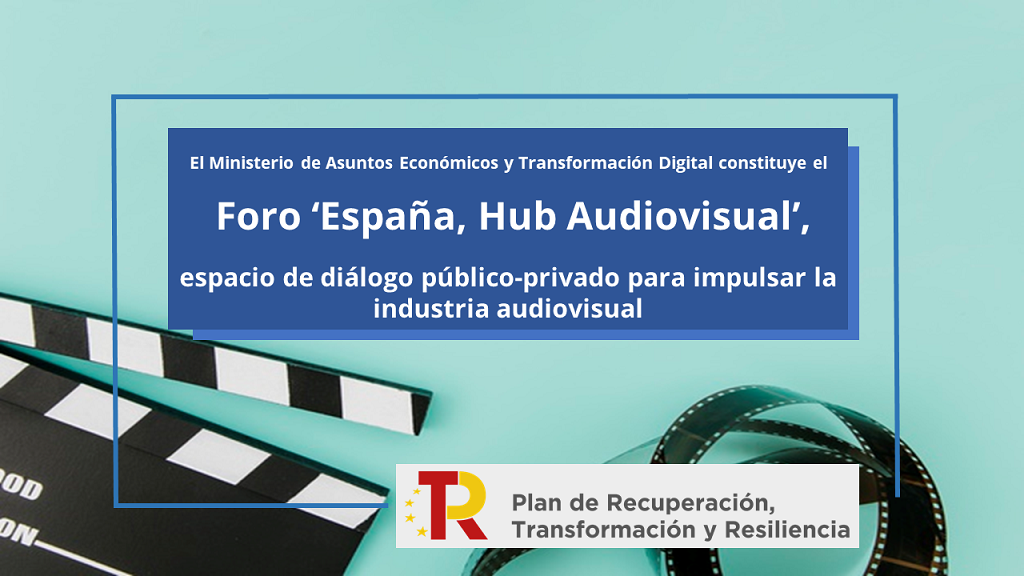
The Ministry of Economic Affairs and Digital Transformation is the Forum ‘Spain, Audiovisual Hub’, a space for public-private dialogue to boost the audiovisual industry
14/07/2021
This Thursday the first meeting of the Forum ‘Spain, Audiovisual Hub’ was held, a space for dialogue and public-private collaboration that will help boost the measures and investments foreseen in the Audiovisual Sector Impulse Plan, “Spain, Audiovisual Hub of Europe. This forum is one of the instruments of governance envisaged and its constitution is in addition to that of the Interministerial Working Group, created on 4 May.
This Thursday, the first meeting of the Forum ‘Spain, Audiovisual Hub’ was held, a space for dialogue and public-private collaboration that will help boost the measures and investments foreseen in the Plan to Boost the Audiovisual Sector, “Spain, Audiovisual Hub of Europe. This forum is one of the instruments of governance envisaged and its constitution is in addition to that of the Interministerial Working Group, created on 4 May.
Agents from the entire value chain of the audiovisual sector are present at the forum. About thirty associations representing technological companies, radio and television companies, both private and public, and companies in the audiovisual field of the different subsectors participate: film production, series, videogames, animation, videogames, advertising production. In addition, the Ministries involved in the implementation of the Plan participate in the forum.
During the meeting, in addition to the formation of the Forum, the Ministry of Economic Affairs and Digital Transformation, the Ministry of Industry, Trade and Tourism, and the Ministry of Culture and Sports presented in detail the measures and budget of the Audiovisual Sector Impetus Plan. Other actions that have been exposed include the investments and reforms that will be undertaken to boost the sector within the Recovery, Transformation and Resilience Plan.
Plan to boost the audiovisual sector
The Plan to boost the audiovisual sector, ‘Spain, Audiovisual Hub of Europe’, has a public investment of 1,603 million euros for the period 2021-2025, of which 200 million euros correspond to the resources of the Recovery Plan.
‘Spain, Audiovisual Hub of Europe’ is based on a broad conception of the audiovisual sector, encompassing not only traditional audiovisual content (fiction, production of audiovisual content, animation, etc. ), but also the multimedia and interactive digital environment, such as software development, video games, eSports and transmedia content or those that incorporate immersive experiences with visual effects or virtual reality.
The goal is to increase at least 30% of audiovisual production in Spain by 2025. The Plan also aims to create new distribution and marketing channels, boost the industry in the sector and diversify the supply of content for citizens.
To this end, it establishes a road map with 15 measures grouped in four axes: promotion and digitization of audiovisual activities, promotion and internationalization and attraction of investments; improvement of financial and fiscal instruments; availability of talent and development of human capital; and regulatory reforms and elimination of administrative barriers.