
Broadband coverage at 100Mbps reaches 88% of the population and the rural digital divide is reduced, after improving coverage 25 points since June 2018
18/05/2021
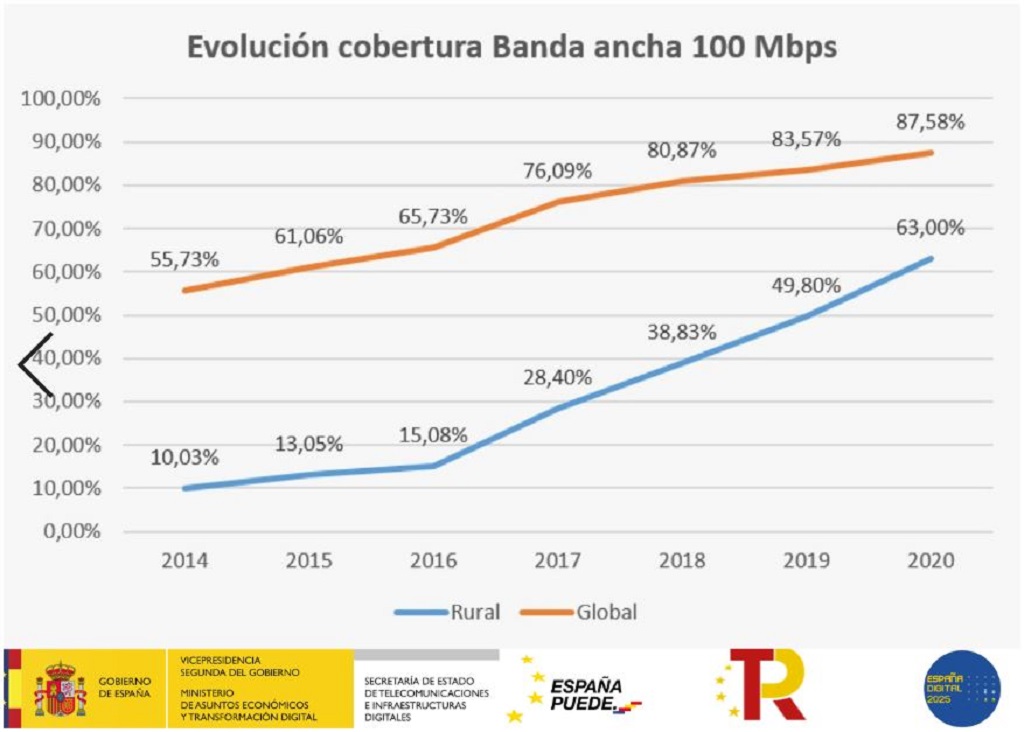
Broadband coverage at 100Mbps reached 88% of the population in 2020, after rising four points since 2019, and reaches 63% in rural areas, an increase of 13 points in a year.
Broadband coverage at 100Mbps reached 88% of the population in 2020, after rising four points since 2019, and reaches 63% in rural areas, an increase of 13 points in a year.
These data are contained in the report “Broadband coverage in Spain in 2020”, prepared by the Ministry of Economic Affairs and Digital Transformation with figures for the month of June last year.
In terms of broadband coverage with a speed of 30Mbps, coverage reaches 95% of the population and 90% in rural areas, practically disappearing the digital divide. During 2020 the rural digital divide in the coverage of this speed has been reduced by four percentage points. In 2019, the percentage was 94% in the whole of Spain and 87% in rural areas.
The report notes the widespread increase in coverage in the last two years, as a result of the strong boost given by the Government to the Broadband Extension Program in 2018 and 2019, providing half of the investments made in its more than six years of history.
To this is added the requirement in 2018 for operators to comply with the obligations undertaken to guarantee a coverage of 30 Mbps or greater at least 90% of citizens living in population units of less than 5,000 inhabitants. With all this, broadband coverage at 30 Mbps speed since 2018 has improved ten points and the speed of 100 Mbps, 7 points.
By technology, fiber optics to the home (FTTH), which allows data transmission services at speeds of 100 Mbps to all users and scalable to more than 1Gbps, has increased five percentage points and reaches 84.9% of the Spanish population, almost one million homes more than in 2019. Fiber optic coverage also reaches for the first time more than half of the population living in rural areas, with a population coverage of 60% in those areas.
The fiber optic coverage places Spain in a prominent position at European level. Last year, with five points less coverage, Spain was already, according to the Digital Economy and Society Index (DESI), the third European country with the largest extension of the fiber optic network, only surpassed by Latvia and Iceland.
Prospective coverage
The report includes the coverage forecast in addition to the one existing in June 2020 which will be reached once the projects under implementation under the Broadband Extension Plan (PEBA-NGA) (co-financed by the European Regional Development Fund, ERDF) are completed.
When these projects are implemented between 2021 and 2023, the ultra-fast speed coverage (100 Mbps) will reach 92.7% of the Spanish population and 82.5% in rural areas, which means reducing practically ten percentage points the difference in coverage between rural areas and the territory as a whole, a difference that in 2018 was forty percentage points. Likewise, fiber optic coverage will exceed 90% of the population (90.3%).
Finally, the report includes for the first time the coverage of 5G mobile networks in the preferred bands and points out that, by mid-2020, commercial service was available in 21 cities, with coverage of 50% of them, which means 12.5% coverage nationwide. The coverage measurement was carried out prior to the launch of commercial offers by all operators.
The methodology of this report has been aligned with that used in the European Broadband Report published annually by the European Commission. Data collected from the incumbent operators of broadband networks referred to on June 30, 2020 have been used and the data of the National Statistics Institute (INE) 2019 of resident population in Spain, 47,026,208 inhabitants, distributed in 8,131 municipalities and 61,818 unique population entities have been taken into account.
Coverage information allows us to monitor progress in achieving the goal of guaranteeing adequate connectivity to 100% of the population, including both the Internet and the Internet. Recovery, Transformation and Resilience Plan as in Plan for Digital Connectivity and Infrastructures.
With this objective, we will proceed to a renewal of the methodology of next year’s report, evolving from the identification based on Singular Population Entities to that based on cadastral plots, which will allow greater granularity. This methodology has already been applied in 2021 in the public consultation to identify the areas that require aid for broadband extension.
Digital connectivity, along with the deployment of 5G networks and cybersecurity, is one of the components of the Recovery Plan, which envisages a public investment of 4,000 million euros until 2023 in these areas.
In order to identify new instruments to continue improving digital connectivity until reaching 100% coverage, the Ministry of Economic Affairs and Digital Transformation has published a request for expressions of interest in order to receive proposals that, through a public-private partnership model, allow the extension of very high-speed broadband and advance 5G coverage in rural areas and areas of low population density, thus promoting territorial cohesion and digital transformation.