The Government reinforces its commitment to the audiovisual sector with the creation of the Spain Audiovisual Hub Fund, worth 1.5 billion euros and which is expected to be approved in the coming weeks
23/09/2023
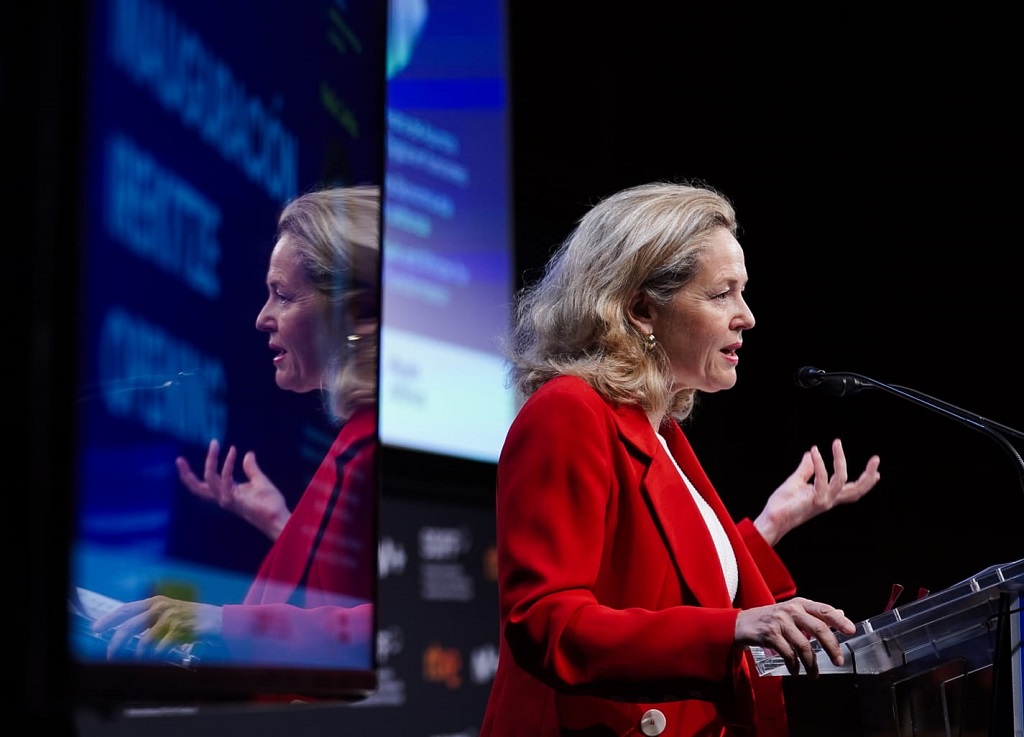
The First Vice-President and Acting Minister for Economic Affairs and Digital Transformation, Nadia Calviño, has reaffirmed the commitment of the Spanish Government to continue strengthening the audiovisual sector, in which it is planned to invest 1.5 billion euros through the Spain Audiovisual Fund, whose creation is being finalized for negotiation in the second phase of the Recovery, Transformation and Resilience Plan.
The First Vice-President and Minister of Economic Affairs and Digital Transformation in office, Nadia Calviño, has reaffirmed the commitment of the Government of Spain to continue strengthening the audiovisual sector, in which it is planned to invest 1.5 billion euros through the Spain Audiovisual Fund, whose creation is being negotiated in the second phase of the Recovery, Transformation and Resilience Plan
“We hope that in the coming weeks the European Commission will give us a positive assessment of the addendum, with which we will create the Spain Audiovisual Hub fund, endowed with 1.5 billion loans managed by the Official Credit Institute (ICO), pointed out during the inauguration of the day ‘Construction, collaboration and investment in the European audiovisual system’ within the framework of the 71st edition of the San Sebastian International Film Festival (SSIFF) on behalf of the Spanish Presidency of the Council of the European Union.
During his speech, he recalled that Spain has allocated more than 20 billion euros of European funds. Next Generation EU a Digitalization, part of them for the audiovisual sector because “we want it to be a modernization tractor sector”.
A fact highlighted by the Secretary of State for Telecommunications and Digital Infrastructures, María González Veracruz, in her closing speech to highlight the strategic importance of the audiovisual industry for the Government. "We are the only EU country that has dedicated Next Generation EU funds to the audiovisual sector," he said, stressing that the goal is to make this bet sustainable. The audiovisual industry, the companies of the sector are “not only cultural wealth but also economic wealth, of employment… It is an honor that the most international international partners recognize us as ‘the place to be”.
The session, organized by the Ministry of Economic Affairs and Digital Transformation through the Secretary of State for Telecommunications and Digital Infrastructures, was attended by the Deputy Director-General for Communication Networks, Content and Technologies of the European Commission, Renate Nikolai, who highlighted the crucial moment in the sector, urging the member states to define a strategy: “It’s time to actively engage together and with ambition.”
Nikolai has also valued the Spanish support to the sector through the Spanish Audiovisual Hub of Europe plan and the model that follows in which the cultural and the economic converge.
The day brought together outstanding personalities and professionals from the sector, who have deepened the challenges for the construction of a European audiovisual system that is based on collaboration and economic sustainability with the support of the public and private sectors.
Throughout the day on the European audiovisual ecosystem, held in the framework of the 71st San Sebastian Festival on the occasion of the Spanish Presidency of the Council of the EU, reflection has been given on consolidation, collaboration and investment in the industry to continue growing and be even more competitive.
Three tables, three approaches
The first round of analysis has revolved around the ‘Consolidation of the business models of the European audiovisual sector’ with the moderation of Cristina Morales (Deputy General Director of Audiovisual Communication Services of the Ministry of Economic Affairs and Digital Transformation) and with the participation of Mario Gianani, CEO of Wildside; José Antonio Antón, Director of Content Atresmedia Television; Jan Motjo, CEO of Beta Films; Domingo Corral, Director of Content of Content and Entertainment of Movistar Plus; Director of Films.
In this panel, we have pointed to the need for collaboration and internationalization to continue the scale we are achieving, arguing that the combination between having a local scale and having achieved international alliances is key. The competitiveness of large international platforms is good because it grows, but it is essential to have European production sovereignty to strengthen our system for our culture.
Collaboration between formats
Next, the second panel focused on the adaptation of formats under the title of ‘Promoting collaboration in various sectors and format’. The moderator was Henar León, Project Manager by Podium Podcast, which has counted several milestones of productions in the field. The writer, Javier Castillo, and the director of original content for Netflix in Spain, Verónica Fernández, have delved into ‘La Chica de Nieve’. Sobre ‘Tadeo Jones’ han puntualizado Daniel Sánchez, CEO de Gamera Nest; y Nico Matji, Cofundador de Lightbox Studios. And in the case of the production of ‘The Three Musketeers’, Yolanda del Val Guilabert, director of the Fiction department of DeAplaneta, has intervened; and Marie Laure Montironi, EVP International off Pathé Films.
In it they have pointed out that we are on the right path because only by looking back and seeing what the industry was like 10 years ago it is obvious that conditions for all have improved a lot because we have been put on the map in another way. Progress is being made on a very long and complex journey, starting at a time when Youtube did not even exist, and we have been adapting formats of movies, games and even musicals with different contents.
The key to funding
The last of the tables was purely industrial, revolving around ‘Investment models in the European audiovisual sector’, moderated by Alberto Sanz, Director of Financing and Investor Relations at ICEX-Invest in Spain. In it, the new options opened up for the sector have been analyzed by Nathalie Cholet, responsible for the Media Invest Fund in the European Investment Fund (EIF); Ramón Garnica Arocena, partner of Nazca Capital; Olivia Sleiter, Head of Production Global Drama of Fremantle; and José Carlos García de Quevedo, President of the Institute of Official Credit (ICO).
The debate has revolved around improvements to the financial instruments, taking into account that timing is really important for the sector and many measures aim to speed up the processes for our producers while respecting their freedom and without forcing their way of working. Particularly relevant has been the contribution on the financing of the ICO in the audiovisual sector with a whole catalogue of tools and another