Spain is above the European average in Digital Skills
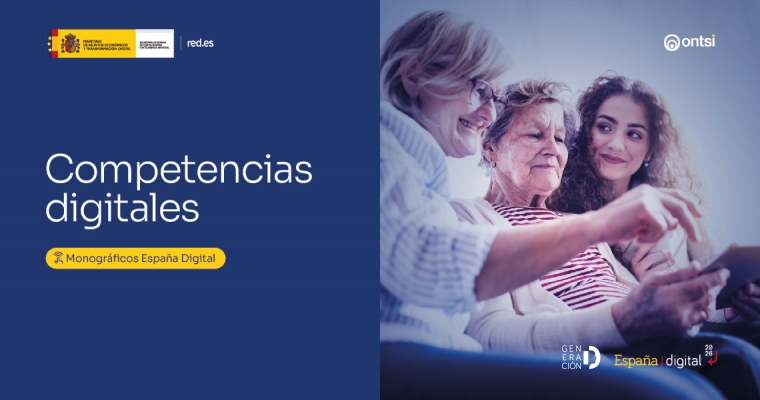
Spain has digital skills levels above the European average, after having experienced a constant improvement in this area in recent years, according to data from the monograph “Digital Skills”, published by the National Observatory of Technology and Society, ONTSI, attached to the Ministry of Economic Affairs and Digital Transformation, through the Secretary of State for Digitalization and Artificial Intelligence.
The impetus on the part of the Public Administrations and society as a whole has brought Spain closer to the objective of 80% of the population with basic or superior global competences, set by the European Commission for 2030. Currently, 64% of Spanish citizens already meet this objective. Spain has also managed to reduce the digital gender gap, and now there is only a 3 percentage point difference, in favour of men. Today, Spain is in sixth place in the European Union in percentage of women with basic or superior global digital skills (63% of women compared to 66% of men).
With regard to digital specialists, key to the development of the digital economy, Spain is below the European average, with 4.1% of working people who are digital specialists, compared to 4.5% in the European Union. In this area there is a very significant gender gap, only 19% of digital specialists are women.
The figures coincide with the last report DESIThe European Commission's Index of the Economy and Digital Societies 2022, which also refers to Spain as one of the leaders of the European Union. EU In terms of connectivity, occupying the number 3 position for the second consecutive year.
National Digital Skills Plan: Pact for Generation D
In the European Year of Digital Skills, and within the framework of the Plan of Recovery, Transformation and Resilience, Spain Digital 2026, the National Plan of Digital Skills, launched at the end of 2022, the Project “Pact for Generation D”, a commitment between more than 50 administrations and public entities, companies, associations, foundations, social agents, Third Sector and media, to provide citizens with digital knowledge and skills. The Plan is already well advanced, with ongoing digitization programs at school, vocational training centers, and the university, or aimed at training for employment, SMEs, and of vulnerable groups.
More than 315,000 people have already been trained, more than 98,000 are in the process of being trained, and more than 1.5 billion euros have been implemented in the project. And the counter keeps going up. Para visibilizar la oferta de cursos e iniciativas que en materia de competencias digitales se imparten por toda España, sirve de altavoz el Collaborative web portal, which also offers a self-diagnostic questionnaire, to know the personal level in digital skills.
“Initiatives D”
These are just a few of the D initiatives accessed from the “Generation D” portal: Digital Skills for Employment, SEPE, focused on the digital training of unemployed people, and employees; DesArrolladoras, course that trains women in programming technologies with high demand in the labor market; DigiCraft in your school, educational program that aims to train in digital skills to the students of Primary Education, forming for it their teachers of reference, based on the methodology DigiCraft; CODI program, launched by the High Commissioner against Child Poverty, which has the objective to guarantee digital inclusion from childhood,SMEs ⦅⦆, training and mentoring in digital transformation for people of management teams and qualification of people employed in SMEs; Big Data, Web Analytics, Artificial Intelligence, and thus up to a total of 145 courses published today, which in face-to-face mode, or online, are taught by all municipalities of Spain.