
Spain joins the United States and the United Kingdom to launch the OECD Global Technology Forum
20/12/2022
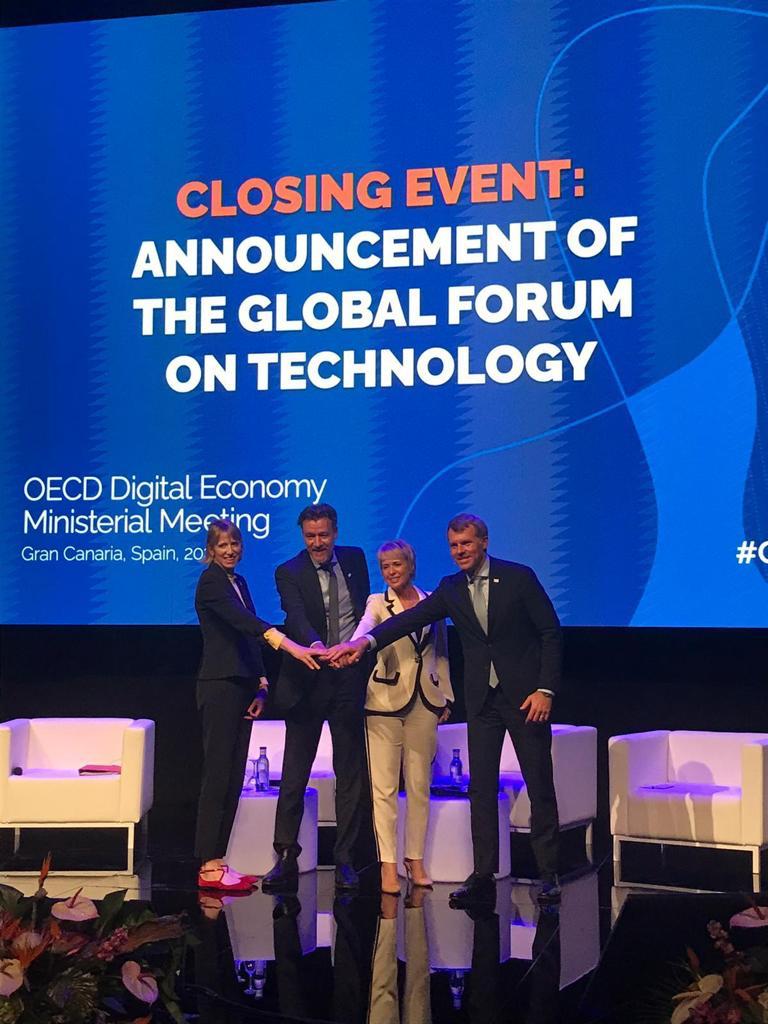
Spain It joins the United States and the United Kingdom to launch the OECD Global Forum on Technology.
Spain, through the Secretary of State for Digitalization and Artificial Intelligence attached to the Ministry of Economic Affairs and Digital Transformation, has joined the United States and the United Kingdom to launch the Global Forum on Technology o Global Technology Forum OECD. The project, announced at the last Ministerial Conference on Digital Economy of the OECD, held in Gran Canaria, aims to establish a fixed place for dialogue on the opportunities and risks of new technology.
This initiative was advanced last September by the United States and the United Kingdom, but has not been effective until now, when Spain has signed up to coincide with the presidency of the Ministerial Conference.
El Global Forum on Technology follow the rules and development of all Global Forums of the OECD, while taking advantage of and joining other international efforts such as the Technology Forum of the Future, which was organized by the United Kingdom during its presidency of G7, or the recent Digital Economy summit of the OECD. A rollout that aims to map out a common roadmap that explores the economic and social opportunities of the digital transition, while analysing its impact on a large scale and making decisions accordingly.
Among future activities, the project would operate at two levels: one with experts, representatives of economic activity and civil society; and another at the highest ministerial or governmental level, with meetings every two years to advance global governance for digital transformation.
The creation of this Forum complements the Declaration for a Reliable, Inclusive and Sustainable Digital Future, signed during the Ministerial Conference, and which reflects the commitment of the member states of the OECD, the European Union and the allied countries to activate a dual transition: digital and ecological. In that sense, the Global Forum on Technology It aims to open a direct channel of communication, exchange and debate to help the societies of these countries adapt and take advantage of this change.
The announcement was made on December 15 by the Deputy Secretary-General of the OECD, Ulrik Vestergaard, the Secretary of State for Digitalization and Artificial Intelligence of the Spanish Government, Carme Artigas, the Director General of Digital Economy of the United Kingdom, Susannah Storey, and the Ambassador of Cybersecurity and Digital Policies of the United States, Nathaniel Flick.
“I’m going to be very honest: the world needs this Forum,” Artigas said at the presentation. “There is still no international organization or entity that considers the implementation of certain emerging technologies throughout society,” he added.
Among Spain’s interests, the deployment of neurotechnology and quantum computing stands out. The first is the National Artificial Intelligence Strategy, to which the Recovery, Transformation and Resilience Plan devotes 600 million euros until 2023, and houses projects such as the pioneering National Center for Neurotechnology, based on the campus of the Autonomous University of Madrid. For its part, the program Quantum Spain, which aims to create a quantum computing ecosystem and contemplates a total investment of 60 million euros, has managed to get Spain selected to host One of the first European quantum computers..
Global Technology Forum Missions OECD
Specifically, the Global Technology Forum would act as a medium and long-term place to engage members and non-members of the Global Technology Forum. OECD in dialogue with industry, trade unions, academia, civil society and technical communities for, among other tasks:
Spain’s participation in the Global Forum of Technology responds to the continued international deployment of the Charter of Digital Rights, a reference guide to put people at the center of digitization strategies.
“We hope that this Forum will provide information on the production of emerging technologies aimed at technological humanism that are part of a future Recommendation on human rights in the digital age,” said Secretary of State Carme Artigas.