Spain climbs two places in the European Commission’s DESI report and consolidates itself as the EU’s most digitised large country
27/07/2022
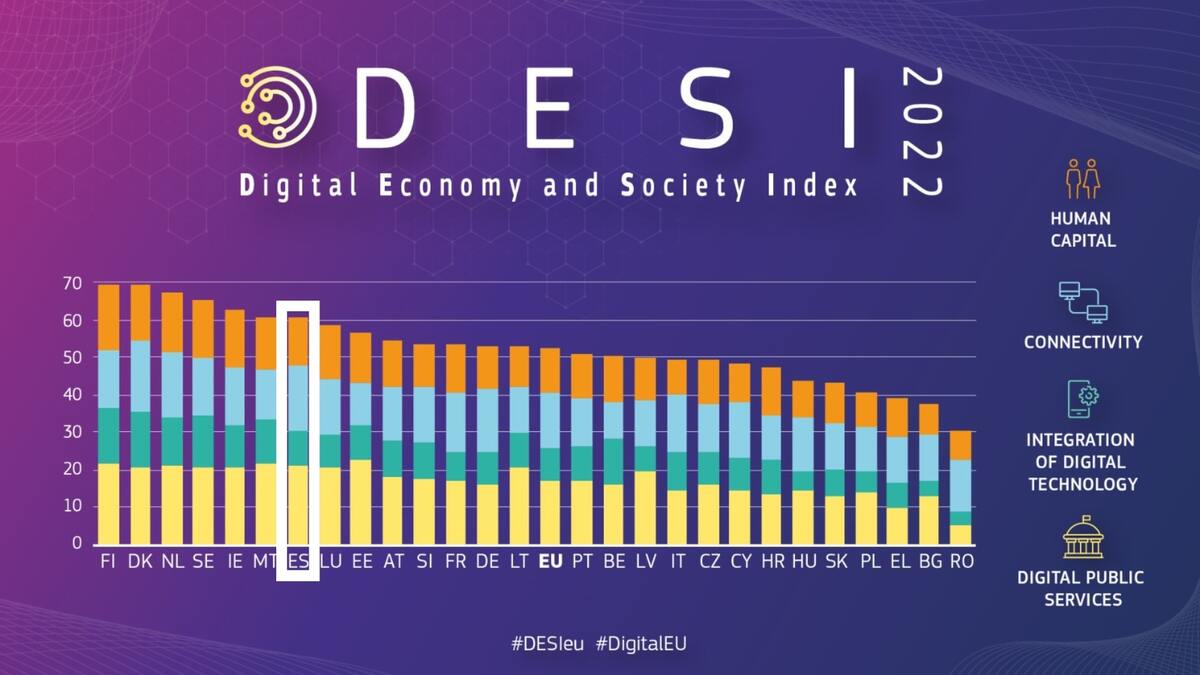
Our country is in seventh position in the EU ranking, ratifying the important advances in digitalization last year linked to the investments and reforms of the Digital Spain Agenda and the Recovery Plan.
Spain continues to be the largest and most digitalized country in the European Union’s Member States, as can be seen from the Digital Economy and Society Index (DESI) published today by the European Commission, which classifies the countries of the EU According to its level of digitization and analyzes its progress relative to the last years in this matter.
In this edition 2022, Spain climbs two places with respect to the results obtained in 2021, placing itself in the 7th position of the 27 member states of the EU, ahead of Estonia, Germany, France, Austria, Italy, Portugal and 14 other Member States.
The Deputy Prime Minister and Minister of Economic Affairs and Digital Transformation, Nadia Calviño, has indicated that “Spain’s improvement in the Index DESI It responds to the important advances of the last four years in areas such as the integration of digital technology, digital public services or digital connectivity, thanks to the reforms and investments included in the Spain Digital 2026 agenda of the Recovery Plan, which are having a truly transformative impact on the Spanish economy and society”.
One of the main improvements of Spain in the index DESI It is the integration of digital technologies, in which the number 11 has been reached, five places above with respect to the report of 2021. Among the initiatives launched to achieve this objective, the deployment of the Digitalization Plan for SMEs 2021-2025 and the success of programs oriented to the digitalization of the business fabric such as the Digital Kit stand out.
In this sense, this progress consolidates a percentage of SMEs with a basic level of digital intensity and that use social networks higher than the average EU. The study also reflects a significant margin for improvement in the integration of advanced technologies such as the cloud or big data, which it attributes to the lack of qualified profiles. Therefore, it values the initiatives in which we work from Spain for the acquisition of advanced digital skills for specialists and the promotion of innovation and entrepreneurship in the country, such as the Digital Rights Charter or the Startups Law.
If we talk about digital public services, Spain has climbed two places with respect to the last report to position itself at number 5 and continues to occupy a leading position at European level, being a pioneer in the development of new services, fundamentally in the fields of health, digital identification, cybersecurity, mobile applications and the integration of Artificial Intelligence in the sector.
Connectivity Leaders
Once again, for the second year in a row, Spain is once again one of the leading member states of the EU in digital connectivity, ranking third in the Index DESI. An area in which our country continues to make progress in the deployment of very high capacity networks, especially in fixed networks.
The document refers to the program of Universalization of Digital Infrastructures for Cohesion - UNIQUE-Broadband - to bring the ultra-fast connection to 100% of the population in 2025. The European Commission also stresses that the gap between urban and rural areas is closing and highlights the regulatory and legislative reforms carried out to boost the deployment of 5G technology within the framework of the Recovery Plan.
In terms of human capital, Spain reaches the 10th position, compared to the 12th position obtained last year. One area in which the good results stand out is the rate of people with at least basic digital skills, in which Spain is 10% higher than the average EU (64% versus 54%). In this area, our country has increased significantly in recent years thanks to the implementation of the National Digital Skills Plan, one of the essential pillars of our digitalization strategy, which has as its final objective that 80% of the population have basic digital skills.
How the data reflect the DESI, Spain is one of the countries that is leading the digital transformation process. In this context, it should be noted that within the framework of the next Ministerial Conference of the OECD Spain will also host the meeting of the D9+ group, which brings together the 9 most digitised economies in Europe and currently consists of Belgium, Denmark, the Czech Republic, Estonia, Finland, Ireland, Luxembourg, the Netherlands, Poland, Portugal, Spain and Sweden.
About the Digital Spain Agenda 2026
The Digital Spain Agenda – launched by the government in July 2020 and updated at the beginning of July – is one of the fundamental pillars of the Recovery, Transformation and Resilience Plan. It constitutes a roadmap for the digital transformation of the country, through investments and reforms. The Government plans to allocate a budget of 20 billion euros for deployment, which represents 30% of the total investments foreseen in the Recovery Plan.