Spain accelerates digital transformation and places itself on the European podium of connectivity
01/12/2021
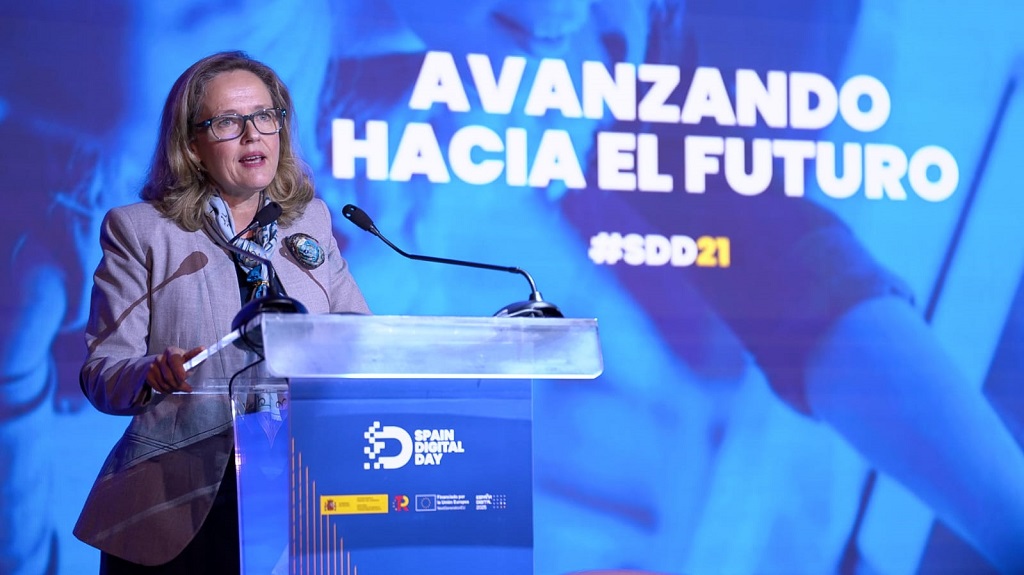
The Government has presented today during the event ‘Spain Digital Day 2021’ the main advances made in the Spain Digital Agenda 2025, which is part of the Recovery, Transformation and Resilience Plan, whose results place the country among the first European states in connectivity.
The Government has presented today during the event ‘Spain Digital Day 2021’ the main advances made in the Spain Digital Agenda 2025, which is part of the Recovery, Transformation and Resilience Plan, whose results place the country among the first European states in connectivity.
Agenda España Digital 2025 is the roadmap that drives the digital transformation of the country and has a budget of 20,000 million euros for the period 2021-2023, almost 30% of the total funds of the Recovery Plan.
The First Vice-President and Minister of Economic Affairs and Transformations, Nadia Calviño, has taken stock of the results obtained in eight areas of action: connectivity, cybersecurity, 5G, digital administration, digitalization of SMEs, digital skills, artificial intelligence and the creation of an audiovisual hub. Along with the breakdown of reforms and advances, he has highlighted that for the deployment of the Digital Spain Agenda 2025, 8.8 billion euros will be invested in 2021-2022, nine times more than budgeted for 2019-2020, which will allow a technological leap to our country.
In his speech, he highlighted how activity has intensified in the last quarter of 2021 and is reaching the cruising speed phase in the deployment of the Recovery Plan as a whole. “73% of this year’s budget is authorized, nearly 60% committed and we have $10.4 billion allocated.”
With the aim of making progress in the eight areas of the Digital Spain Agenda, the Government has published eleven Expressions of Interest throughout the year and has launched six calls with a global allocation of almost 6 billion euros. In addition, three key initiatives for the digital transformation of Spain have been approved: the Draft General Law on Audiovisual Communication and the Draft General Law on Telecommunications and the Charter of Digital Rights.
These actions have had an impact on the digitalization of the country as stated by the Secretary of State for Digitalization and Artificial Intelligence, Carme Artigas, and the Secretary of State for Telecommunications and Digital Infrastructures, Roberto Sánchez. Both have presented the milestones achieved this year and have highlighted the importance of public-private collaboration to promote the development of the Digital Spain Agenda 2025 through the Consultative Conference on Digital Transformation, the sectoral commissions with the Autonomous Communities and other forums for dialogue with the private sector.
Main advances
In the field of digital connectivity, Spain is the third country with the best connectivity in Europe (5th position in 2020). 92% of the population and 65% of rural areas have broadband coverage, according to the Economy and Society Index carried out by the European Commission (DESI). The Universalization of Digital Infrastructures for Cohesion Programme (UNICO), launched this year with an allocation of 250 million euros - the largest in the history of broadband programmes - will allow us to continue moving towards universal coverage.
Within the framework of this programme, 205 million euros have been allocated this year to the autonomous communities to improve the connectivity of public buildings such as hospitals and schools; enhance the connection of companies or industrial estates; provide connectivity vouchers to vulnerable families and improve telecommunications facilities in buildings built before the year 2000.
The year 2021 has been decisive for the promotion of 5G technology by making available to operators the two priority bands for its development. On the one hand, the 3.6 MHz band has been rearranged and, on the other hand, the frequencies of the 700 MHz band have been listed.
Eight new 5G pilot projects have also been financed, in addition to the two that were under way and that will explore more than 120 use cases with an aggregate budget of 40 million euros and 12 million in aid, financed with ERDF funds. In addition, 115 projects from thirteen public research institutions worth 95.2 million euros have been granted grants to boost Spanish leadership in advanced 5G and 6G, and 26 million euros are being invested in the deployment of 5G on high-speed railway tracks, in collaboration with ADIF.
In addition, a further step has been taken to continue promoting investment in digital infrastructures with the approval of the General Telecommunications Bill, which is now beginning its parliamentary procedure, and the text of the draft Cybersecurity Bill 5G is being finalized so that it can also be approved.
More digital competencies and greater cybersecurity
At the beginning of 2021, the National Digital Skills Plan was presented with an investment of 3.75 billion euros. With the objective that in four years 80% of the population will have basic digital skills. Currently, 57% of the population has this type of competence.
Among the measures launched this year in this area are: the constitution of the Digital Skills Hub; the Educa en Digital program, and the distribution of 140 million to communities for training in digital skills to citizens. It highlights, in turn, the investment of 300 million euros in Professional Training for new training linked to digital or the inauguration of “Aula del Futuro”, the first of a network of spaces dedicated to training teachers in digital skills and STEAM.
In the field of cybersecurity, the implementation of Helpline 017 can be highlighted, with which 47,503 consultations have been attended last year; the Cybercooperant Program