The Radar COVID mobile contagion alert application exceeds its testing phase by meeting all the objectives set
02/08/2020
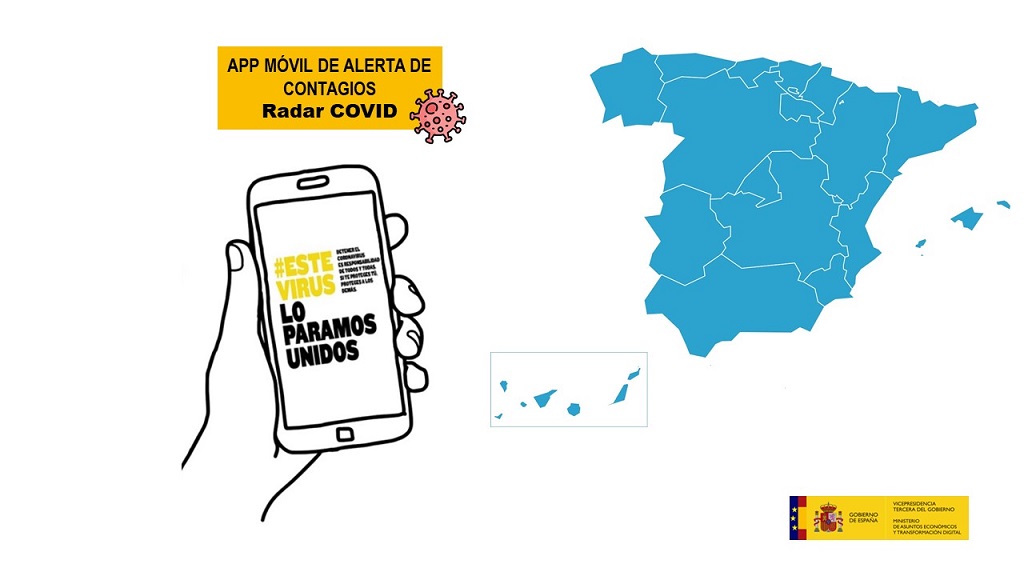
Radar COVID, the infection alert application for mobile phones, has passed its testing phase satisfactorily and is already available to the health authorities of the autonomous communities.
Radar COVID, the infection alert application for mobile phones, has passed its testing phase satisfactorily and is already available to the health authorities of the autonomous communities.
This is what the Secretary of State for Digitalization and Artificial Intelligence, Carme Artigas, explained at a press conference in which she shared the results obtained during the pilot. She was also joined by Pilar Aparicio, Director General of Public Health and Innovation of the Ministry of Health, Pablo Hernández, Director General of Modernization and Quality of Services of the Canary Islands Government, Santiago Graña, Deputy Director General of Promotion of Digitalization of the Administration, and Pablo Rodríguez, technical advisor of the project.
Adoption success, engagement, retention and performance
The test started on June 29 and has been developed until this past July 31, during which time four waves of fictitious COVID-19 outbreaks have been simulated. During its development, and despite the fact that it only worked on the island of La Gomera, more than 60,000 people downloaded the app throughout Spain.
The first objective of the pilot was to evaluate precisely the adoption of the tool, that is, the number of people who would download it, and a target of 3,000 participants was set for La Gomera, a goal that has been exceeded according to the data obtained during the test.
A second objective was to measure retention, referring to the number of users who kept the app active after downloading it. The results, also satisfactory, point to an 83% average retention achieved.
In addition, the commitment of users in the communication of fictitious positives was analyzed, achieving 61% of active communications, of which 78% occurred within 24 hours after receiving the simulated contagion code.
Another of the objectives outlined in the pilot was to measure the operation of the app in the contact tracing, achieving an average of 6.4 close risk contacts detected by confirmed simulated positive. This figure almost doubles the current efficiency of manual tracers, which detect an average of 3.5 contacts in the Canary Islands.
Favorable user reviews
Through interviews and questionnaires, the opinions of users regarding their experience of use have also been collected. All respondents say they will continue to use the app when it is active nationwide, and almost all (82%) value it as a useful tool in the prevention of COVID-19 infections. The overall assessment of the tool has reached in these questionnaires a score of 8.2 out of 10 possible points.
By category, the highest ratings have corresponded to the willingness of users to recommend the app to their environment (9.2 out of 10), ease of use (8.6), understanding of instructions (8.7) and the feeling of privacy and anonymity (8.6).
Next steps and deadlines
Once the approval of the health authorities has been received, the next step has been to make this application available to the autonomous communities, as the President of the Government did last Friday at the XXI Conference of Presidents. The autonomous communities that wish to do so will be able to connect the tool with their health notice management systems.
Given the current situation, with the appearance of some outbreaks of contagion located in regions once mobility has recovered, a first functional version of the tool could be available for a specific start-up in mid-August.
The deployment to the rest of the national territory, should the autonomous authorities so decide in the exercise of their powers, would arrive in mid-September.
Running the app
Radar COVID follows the most guaranteed technical standards with the privacy of users in compliance with all the recommendations made by the European Commission in this regard. In this way, no user can be identified or located because there is no data registered and because the whole process takes place on your phone without leaving to any server. Both the use of the app and the communication of a possible contagion will always be voluntary.
The application uses the Bluetooth connection of the terminal, through which mobiles emit and observe anonymous identifiers of other phones that change periodically. When two terminals have been close for 15 minutes or more two meters or less away, both keep the anonymous identifier issued by the other.
If any user were diagnosed positive for COVID-19 after a PCR test, he would decide whether to give his consent so that, through the health system, an anonymous notification can be sent. In this way, mobiles who had been in contact with the patient would receive a warning about the risk of possible contagion and instructions on how to proceed would be provided. By not requesting data of any kind, it is impossible to identify or locate any user in any way.
Currently, the European Commission is developing the legal and technical framework that makes possible interoperability between applications based on the decentralized model, as is the case of Radar COVID, so that they can continue to operate beyond the borders of each State. The Spanish Government has defended from the outset an interoperable model to extend the scope of this type of tools.