The Government strengthens its alliance with the digital sector in Barcelona
23/02/2020
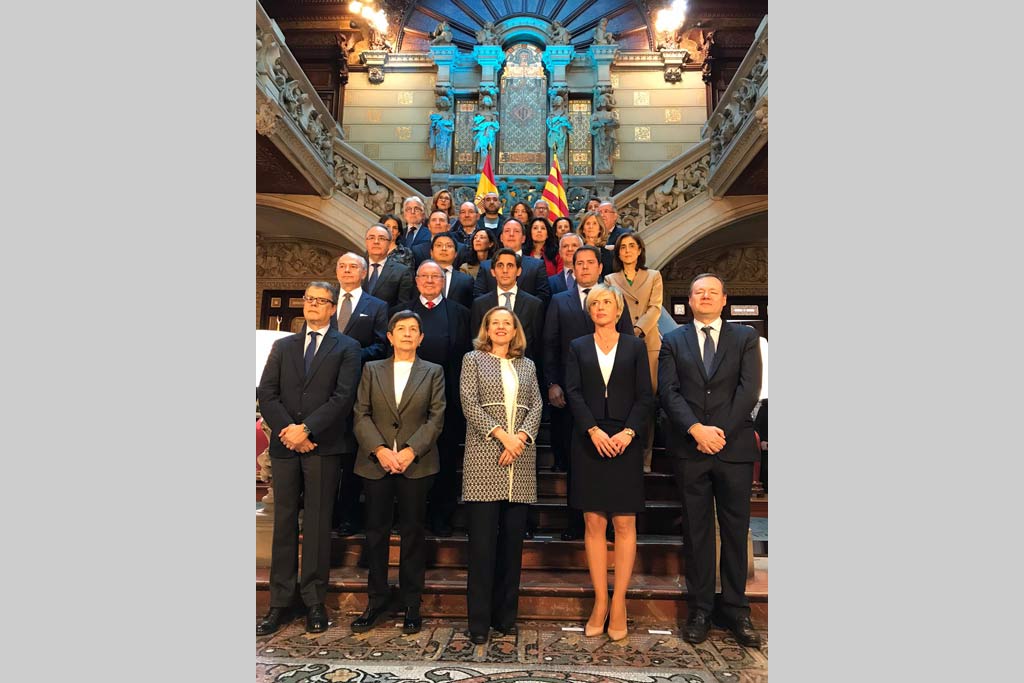
The Third Vice-President and Minister of Economic Affairs and Digital Transformation, Nadia Calviño, has transferred on Monday in Barcelona to companies, social agents and institutions the commitment of the Government to the digital sector and has reaffirmed the support to the city as an engine of new technologies and entrepreneurship.
The Third Vice-President and Minister of Economic Affairs and Digital Transformation, Nadia Calviño, has transferred on Monday in Barcelona to companies, social agents and institutions the commitment of the Government to the digital sector and has reaffirmed the support to the city as an engine of new technologies and entrepreneurship.
The vice-president, who has been accompanied by the Secretary of State for Digitalization and Artificial Intelligence, Carme Artigas, and Telecommunications and Digital Infrastructure, Roberto Sánchez, has had an intense day of contacts in Barcelona, in which she has also presented the process of elaboration of the Digital Agenda that the Government will develop in the next four years.
The day began with a visit to Tech Spirit Barcelona, an event that brings together hundreds of local start-ups. After touring some of the facilities around this forum, the vice-president has met The Collider, an innovation program promoted by Mobile World Capital Barcelona.
The Vice-President welcomed the initiatives that have emerged to take advantage of the technological ecosystem developed in Barcelona over the years thanks to the celebration of the Mobile World Congress and reiterated the commitment of the Government to the celebration of this event next year.
Subsequently, the Vice-President moved to the Government Delegation in Catalonia, where she held a meeting with representatives of companies in the technology sector and social agents. Among them were the President of Telefónica, José María Álvarez-Pallete; the President of Microsoft in Spain, Pilar López; the President of MoreMóvil, Eduardo Díaz-Hochleitner; the CEO of Orange in Spain, Laurent Paillasot; the CEO of Samsung in Spain, Celestino García; the CEO of Huawei in Spain, Toni Jim; the CEO of Cellnex, Tobías Martinez; the CEO of Google, Fuencisla Clemares in Europe.
There have also been, among others, the president of the CEOE, Antonio Garamendi; the president of Cepyme, Gerardo Cueva; the president of the Chamber of Commerce of Spain, José Luis Bonet; the president of Foment del Treball Nacional, Josep Sánchez Llíbre; the president of Pimec, Josep González i Sala; the president of Cotec, Cristina Garmendia; the president of Ametic, Pedro Mier; the president of Adigital, Carina Szpilka, and the president of Digital Alicia.
The meeting, in which the vice-president was accompanied by the government delegate in Catalonia, Teresa Cunillera, was later concluded with a lunch at the Museum of Contemporary Art in Barcelona with representatives of companies in the sector.
In these meetings, the vice-president has outlined the lines that will mark the Digital Agenda with which the Government will seek to lead the digital transformation of society, to ensure inclusive, balanced and sustainable growth.
This new Digital Agenda, which is one of the Ministry’s priorities, will seek to maximize the well-being of society as a whole. To this end, the digital transformation will focus on three aspects: people, society and the economy.
The objective is to guarantee the security and protection of the rights of individuals, with a humanist digitalization, as well as to protect the democratic and constitutional values of society, while working for the efficiency and productivity of the economy, through its digitalization.
This is also the triple focus that the European Commission highlighted in the presentation a few days ago of its digital package – technology for the benefit of people, a fair and competitive economy and an open, democratic and sustainable society – a plan with which the Spanish Government is fully aligned.
The third vice-president assured in these meetings that the Government wants to listen to the entire sector, from the business sector to civil society, in this process of transformation, because she is convinced that this is a way to increase the chances of its success.
The meeting held in the Government Delegation in Barcelona has thus served as the first contact in this process of elaboration of the Digital Agenda, in which the vice-president has committed herself to listen to the representatives of the sector. “For our government, dialogue with citizens, social agents, economic operators and territories is key,” said the vice-president.