
The Secretary of State for Digital Advancement organizes a conference on protection of LGBTI rights on the Internet
25/06/2019
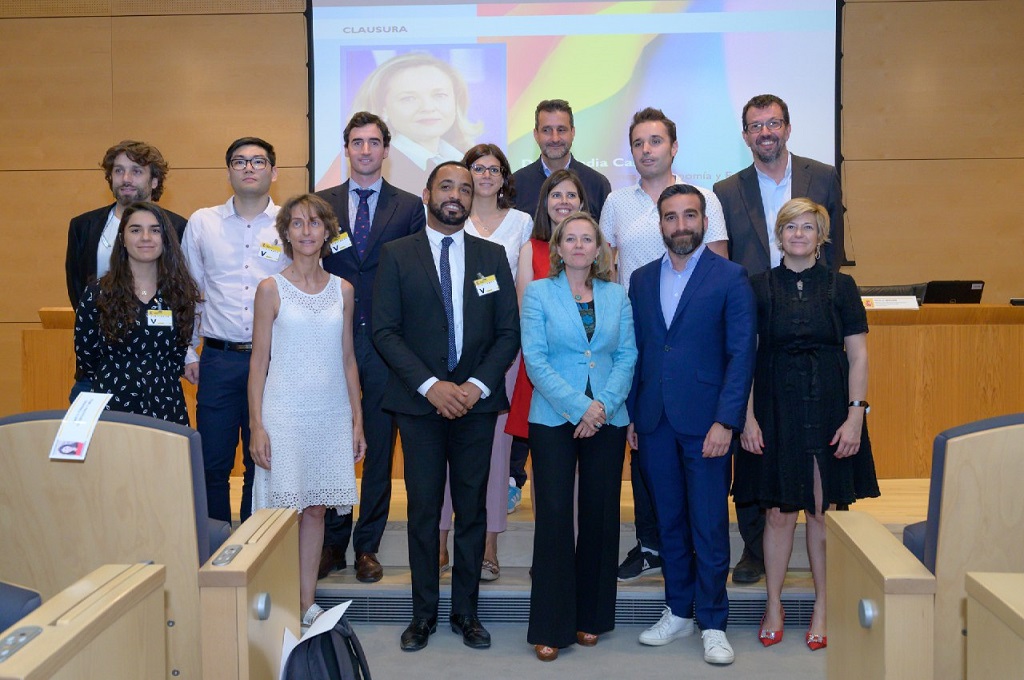
The Secretary of State for Digital Advancement, attached to the Ministry of Economy and Enterprise, has today organized a conference on the protection of the rights of LGBTI people on the Internet. This group receives 19% of hate crimes in Spain, more than half of which are committed through the Internet and social networks, according to data from the Ministry of the Interior.
The Secretary of State for Digital Advancement, attached to the Ministry of Economy and Enterprise, has today organized a conference on the protection of the rights of LGBTI people on the Internet. This group receives 19% of hate crimes in Spain, more than half of which are committed through the Internet and social networks, according to data from the Ministry of the Interior.
The day, framed in the 50th anniversary of the first demonstration of LGBTI Pride, has been closed by the acting Minister of Economy and Business, Nadia Calviño, who has invited to work on the reflection on how to undertake a digital transformation that guarantees equal rights for all citizens. In the minister’s words, digital development must take place with the utmost respect for Article 14 of the Spanish Constitution, which establishes that all people are equal before the law. In this regard, the minister has expressed the Government’s commitment to equality and inclusion, and has outlined some of the actions undertaken during the last legislature. Among them, he mentioned the reform of the Organic Law on Data Protection, which in its Title X seeks to reinforce the rights of people in the digital field, such as the right of universal access to the Network, the right to digital security, the right to digital education and the protection of minors on the Internet, as well as the right to rectification and updating of information on the Network, or the right to oblivion.
In her speech, the minister also highlighted the participation of the Ministry of Economy and Enterprise in the ‘Digital Future Society’, an initiative of the Mobile World Capital Foundation that allows Spain to become a pole of reflection on the humanist dimension of digitalization.
For his part, the acting Secretary of State for Digital Advancement, Francisco Polo, stressed in the opening speech of the day that “the protection of the social rights and freedoms of the LGTBI collective benefits the whole society” and that “in the defense of human rights there can be no distinctions”. Polo has also defended the need for greater awareness and awareness, as well as new actions so that “discrimination does not go unpunished”.
Best practices against discrimination
The day featured a round table on best practices for the inclusion and protection of LGBTI rights, in which participated Rubén López, director of the Madrid Observatory against LGTB phobia; Carlos Morán Ferrés, head of service of the National Office of Fight against Hate Crimes of the Ministry of the Interior; Montse Ramírez, responsible for Communication of FELGTB Campaigns and Projects; and Laura Díez Strong The table was moderated by Marta Fernández Herraiz, founder of the Lesworking platform and co-director of REDI, the business network for LGTBI diversity and inclusion in Spain.
Later lectures were given by Juan Carlos Pereira Kohatsu, author of Hater Net, and Almudena Sanz Olivé, data scientist at Graphext, two technological reference tools in the detection of hate speech on the Internet.
The presentation has been completed with a round table in which the legal scope of the challenge of protecting the rights of people on the Internet has been deepened. Its moderator was Nicolás Marugán, member of the Committee for the Elimination of Racial Discrimination of the UN between 2016 and 2018, and in it participated Miguel Luengo-Oroz, chief data scientist of UN Global Pulse; Carmen Girón Tomás, technical advisor of the Spanish Observatory of Racism and Xenophobia; Patricia Rodríguez Lastras, fiscal equality attached to the Office of Public Prosecutions and Public Affairs. “Young people are the main recipients and broadcasters of hate speech. We have to work to make them the active agents of change,” said Sola, concluding: “Hate speech precedes the commission of a crime. If we wait for that crime to happen, we will have failed.”