Spain advances in the digitization process and remains above the European Union average
10/06/2019
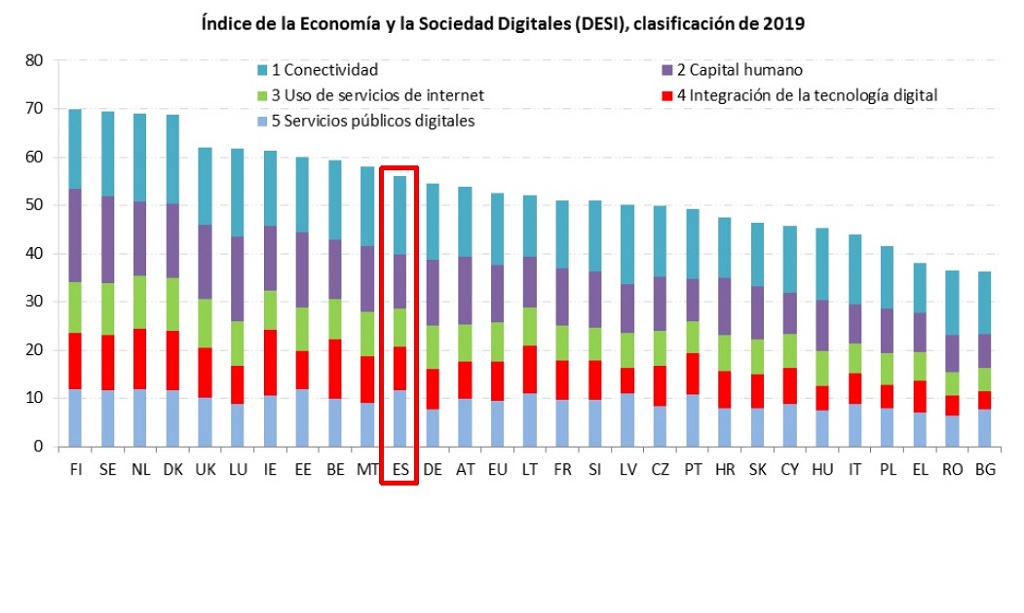
The European Commission has today published the Digital Economy and Society Index (DESI), which annually compares the digital evolution of the 28 countries that make up the European Union. In this edition, Spain maintains the 11th position of the ranking although with an increase in the score and the advantage with respect to the Community average. Our country occupies a prominent place among the group of major European economies, surpassed by the United Kingdom and above Germany, France and Italy.
The European Commission has today published the Digital Economy and Society Index (DESI), which annually compares the digital evolution of the 28 countries that make up the European Union. In this edition, Spain maintains the 11th position of the ranking although with an increase in the score and the advantage with respect to the Community average. Our country occupies a prominent place among the group of major European economies, surpassed by the United Kingdom and above Germany, France and Italy.
The DESI report is composed of five major indicators: connectivity, human capital, internet use, integration of digital technology and digital public services. Each of these indicators, in turn, is calculated from the weighted average of a series of variables or sub-indicators, with data from 2018, 2017 and 2016.
Spain remains at the forefront of the most advanced European countries in terms of digital public services. The Commission's report shows that Spain climbs two positions, up to fourth place in the ranking. Our country also stands out in the connectivity indicator, where it improves one position, up to the 9th place, which puts us above the EU average. This position is achieved despite the fact that none of the variables used specifically measures the deployment of optical fiber, in which Spain occupies a leading position.
The third of the indicators where Spain obtains a significant result is the integration of digital technology, with the 10th place. As for the use of internet services, Spain ranks 11th, the same as the previous two years, although with an increase in the score. Finally, in the field of human capital, our country ranks 17th, as well as the two previous years.
The improvement of human capital is a preferred objective for the Government. Promoting scientific and technological progress and focusing on training and human capital are two priorities of its reform roadmap, the Agenda for Change, which seeks to adjust training to the requirements of the labour market, in particular by strengthening digital, scientific and technological skills.