The Ministry of Economy and Enterprise presents a pioneering book on the regulatory challenges of the digital society
18/03/2019
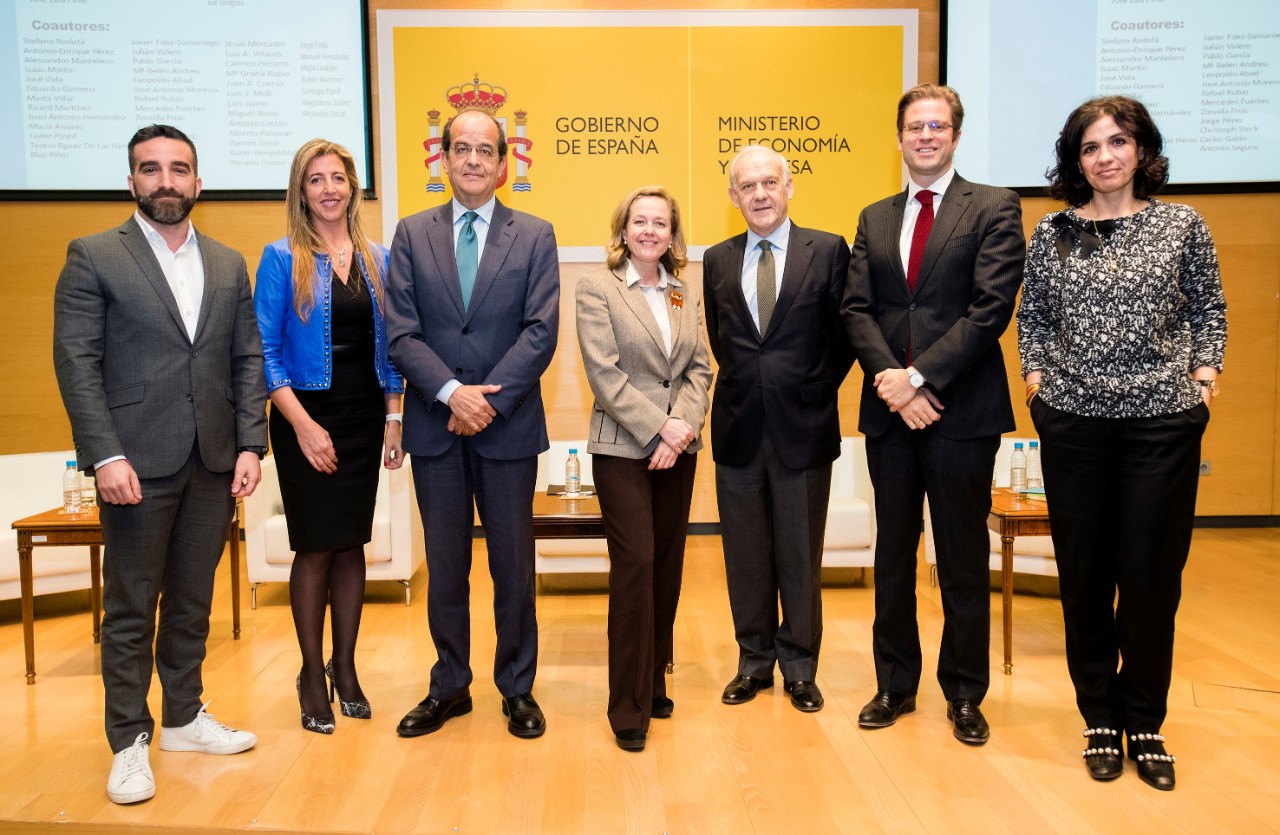
The Minister of Economy and Business, Nadia Calviño, presided this morning the presentation of the book ‘Digital Society and Law’. It is a work that compiles about fifty articles, the first of this kind that raises in our country a reflection in the field of law on the process of digitalization.
The Minister of Economy and Business, Nadia Calviño, presided this morning the presentation of the book ‘Digital Society and Law’. It is a work that compiles about fifty articles, the first of this kind that raises in our country a reflection in the field of law on the process of digitization.
‘Digital Society and Law’ aims to open the debate on the risks and opportunities associated with the digitalisation of society for the protection of the fundamental rights of people and to establish the foundations for future regulatory developments.
Guarantee citizens' rights
In her opening speech, the minister assured that digital transformation is a transversal and unstoppable phenomenon, with a high potential for prosperity. “But if in addition to a prosperous society we want a just society, we must reflect on the implications of that transformation in areas such as ethics and citizens’ rights” he said, adding: “We don’t have the option to decide if we are or not, but we still have the option to decide how we want to be.”
In the minister’s words, access to the digital society is a fundamental right, which forces public and private authorities to continue working to ensure that the internet reaches all citizens on equal terms. In this sense, it has highlighted the recent celebration during the Mobile World Congress of Barcelona of ‘Digital Future Society’, an event promoted by the Ministry of Economy and Business to face the technological transformation from a humanist perspective and discuss how global governance should contribute to place citizens in the axis of digitalization.
Law under construction
The presentation of the book ‘Digital Society and Law’ was also attended by one of its directors, Tomás de la Quadra-Salcedo, who listed some of the risks that, from a legal perspective, involve the digitalisation and convergence of new technologies. “This work is more than just a book of law. Because in this area the challenges are so important, the changes that take place so relevant, that we are facing a law in construction”.
The presentation was completed with a round table moderated by the Secretary of State for Digital Advancement, Francisco Polo, in which participated José Luis Piñar, Professor of Administrative Law at the CEU-San Pablo University and co-director of this work; and the co-authors Teresa Rodríguez de las Heras, professor of Commercial Law at the Carlos III University of Madrid; Christoph Steck, Director of Public Policy and Internet at Telefónica; and Carmen Herrero, professor of Commercial Law at the University of Valladolid.
The book ‘Digital Society and Law’ is already on sale through this link.